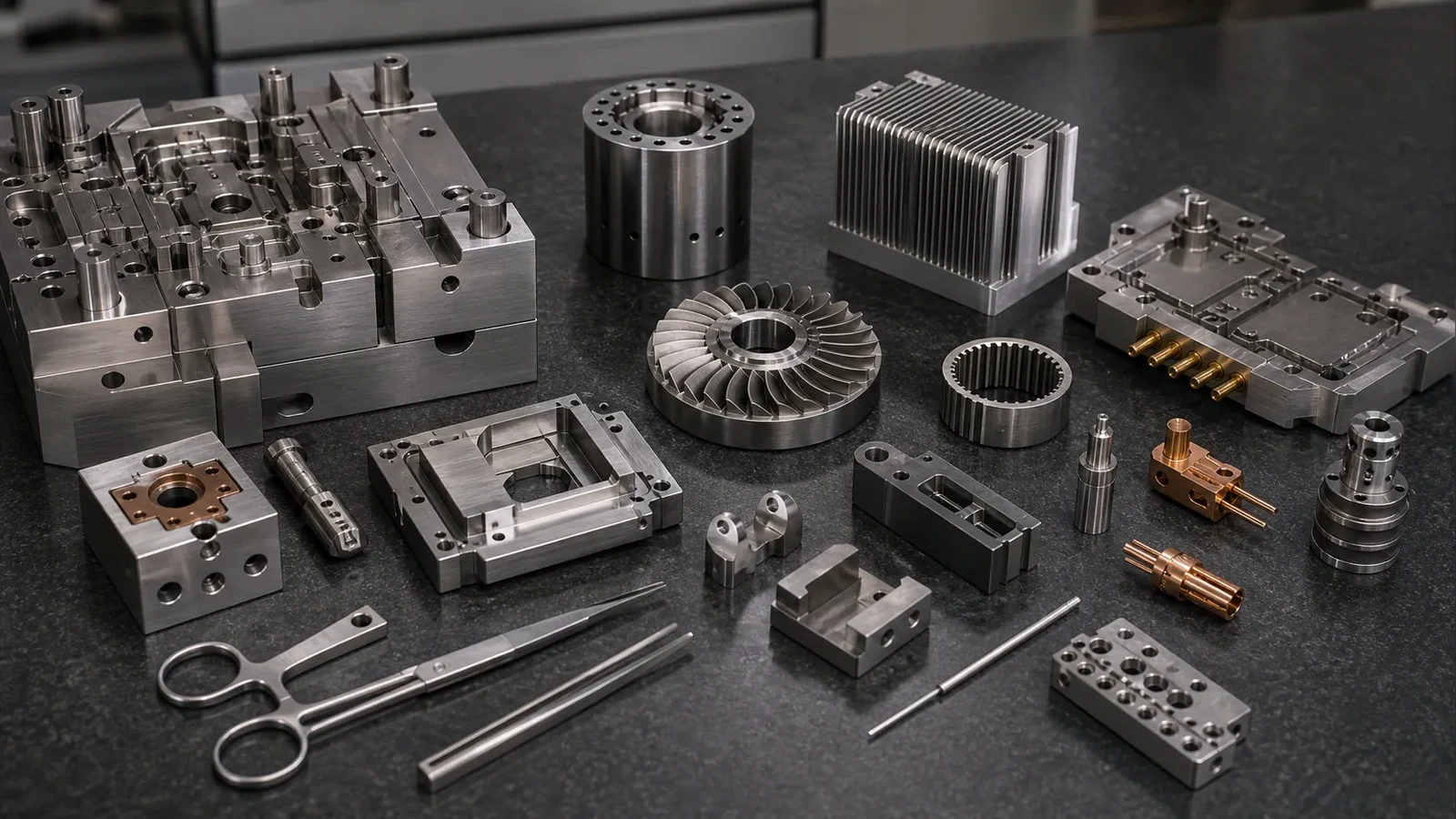
EDM Drawing and RFQ Checklist
A useful EDM RFQ should include drawing files material grade thickness or feature depth tolerance surface finish quantity and inspection requirements.
- Drawing file type
- Material grade
- Critical dimensions
- Tolerance zone

Find EDM machining routes for tooling, precision components, prototypes and industrial parts by application, material and drawing requirement.
Use these application review pages to match your part context with an EDM machining route. Final suitability depends on material, geometry, tolerance, edge condition, surface finish and inspection requirements.
Use application pages when the part function matters as much as the EDM process. The same material can need different review points for mold tooling, medical components, EV tooling, electronics connectors or oil and gas parts.
Identify whether the part is a tooling insert, connector feature, prototype, fixture, cavity, slot, hole or inspection-critical component.
Material grade, thickness, internal corners, blind cavities and through profiles decide which EDM route should be reviewed.
Critical surfaces, datums, tolerance stack, finish requirements and report needs should be included before quotation.
Use this snapshot to decide whether your part should be sent for EDM feasibility review. Final process selection depends on the drawing, material, tolerance, surface finish, quantity and inspection requirement.
Application Review Topics
Use these topics to connect part function, material, geometry, tolerance and inspection needs before choosing the EDM route.
A useful EDM RFQ should include drawing files material grade thickness or feature depth tolerance surface finish quantity and inspection requirements.
Wire EDM fits conductive parts that need through profiles narrow slots sharp internal corners stable cutting force or accurate contours from flat or block stock.
Inspection planning should identify critical dimensions datums surface finish edge condition report needs and any functional surfaces affected by EDM.
Sinker EDM fits conductive parts that need blind cavities ribs pockets or shaped mold features that cannot be produced by through-wire cutting.
Mold and die EDM planning should connect feature type with process choice: wire EDM for inserts and profiles sinker EDM for cavities and shaped features.
Medical EDM review should focus on material grade critical surfaces small features tolerance inspection and any documentation requirements.
Browse EDM application pages by industry family, part context, material and process so a drawing requirement can be matched with a relevant EDM review page.
EDM application pages for mold inserts, die components, tooling details, fixtures and precision tooling materials.
Application pages for medical, dental, implant, micro-feature and inspection-sensitive precision EDM components.
EDM application pages for automotive tooling, EV battery tooling, conductive features, fixture details and production tooling.
Application pages for connector slots, contact features, conductive components and small precision electronics tooling.
EDM pages for oil and gas, energy, marine and demanding industrial components by material and part context.
Application pages for research laboratory parts, prototypes, test samples and small-batch drawing review.
Application pages that connect a specific industry or part family with a specific material grade.
Application pages that connect an industry or part family with an EDM process such as wire EDM or micro EDM.
Upload STEP, STP, DXF, DWG, PDF, IGS, IGES or ZIP files. Include material, thickness, tolerance, surface finish, quantity and any inspection requirements so we can review process fit before quoting.