
EDM Service
Small Hole EDM Drilling
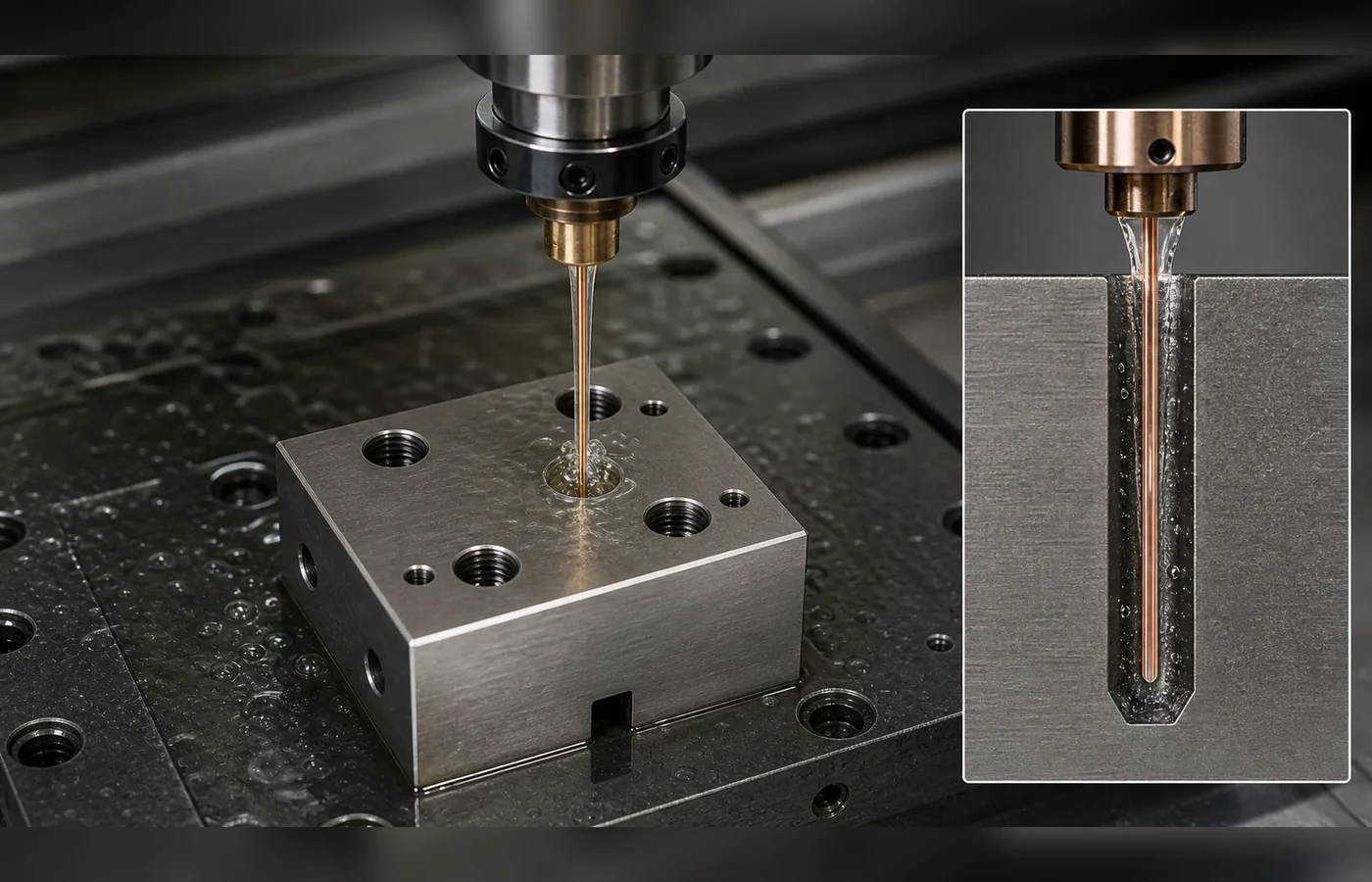
Small Hole EDM drills conductive material with a rotating tubular electrode and high-pressure internal flushing. It drills where mechanical drills become unstable, especially on deep, small, angled, or hardened features that need low cutting force and controlled breakthrough.
Quick Answer
Choose Small Hole EDM from the actual hole diameter, path depth, depth-to-diameter ratio, angle, positional tolerance, and breakthrough condition. Very small diameter combined with extreme depth may require specialized equipment, staged electrodes, and dedicated metrology.
Key Process Decisions
When to Choose This Process
Typical planning tolerance is ±0.010–0.050 mm. Hole-wall finish is feature-dependent—confirm it from the diameter, depth, and energy setting.
What to Watch For
High aspect ratio raises electrode wear, runout, taper, wall-recast, and exit-edge risk. Hole diameter alone does not describe breakthrough quality. We manage this by checking access, support, discharge conditions, and inspection before release.
How the Process Works
Small Hole EDM rotates a tubular electrode while pressurized dielectric flows through the electrode center and exits at the advancing hole tip. The rotation averages electrode runout, and internal flushing removes debris from a path that an external jet cannot reach; this is why the process can drill hard alloys without drill thrust or a broken cutting tool trapped in the workpiece. As depth-to-diameter ratio rises, electrode wear, taper, straightness error, and breakthrough damage rise together, so staged electrodes, through-electrode flushing, and entry-versus-exit inspection become progressively more important.
Small Hole EDM Capability Reference
| What you're asking | What you can expect |
|---|---|
| Feature types | small through holes, deep holes, angled holes, cooling holes, vent holes, and start holes in hard or heat-resistant alloys |
| Tolerance | ±0.010–0.050 mm |
| Surface finish | Hole-wall finish is feature-dependent |
| Typical diameter | About 0.3–3.0 mm for ordinary planning |
| Depth driver | Depth-to-diameter ratio, straightness, and breakthrough |
| Main limitation | Very small diameter combined with extreme depth may require specialized equipment, staged electrodes, and dedicated metrology. |
Surface Control
Inspect the entrance, bore wall, and exit separately. Functional holes may need low-energy finishing or a recast limit rather than one broad part-level Ra value.
Small Hole EDM Drawing Checkpoints
- Choose Small Hole EDM from the actual hole diameter, path depth, depth-to-diameter ratio, angle, positional tolerance, and breakthrough condition.
- State the material grade, condition, controlled dimensions, and the functional surfaces that need a specific finish. Hole-wall quality is feature-dependent—define it from the diameter, depth, and energy setting.
- Use the same datum scheme for machining and inspection, and identify any report or sample-approval requirement.
Typical Parts and Features
- turbine-blade cooling holes
- mold and die vent holes
- injector and nozzle holes
- angled lubrication holes
- medical and precision small holes
- wire-EDM start holes
Limits and Better Alternatives
Consider Another Route When
Use mechanical drilling for accessible easy-cutting material, laser drilling for suitable thin high-volume parts, or Micro EDM for smaller precision features.
Practical Next Step
For a Small Hole EDM quote, send the drawing, material grade and condition, critical dimensions, surface requirements, quantity, and inspection expectations. If the process route is unclear, send what you have and we will map each feature to the appropriate EDM method.
Practical Takeaway
Small Hole EDM drills deep, small, or angled holes in hardened and heat-resistant alloys where mechanical drills are likely to wander or fail.
Request a Machining Feasibility Review
Send material grade, drawing files, tolerance and quantity. We confirm process fit before quoting.
- Drawing or part sketch
- Material grade
- Thickness / part size
- Quantity
- Tolerance and critical dimensions
- Surface finish or inspection requirement
STEP/STP, DXF, DWG, PDF, IGS/IGES or ZIP.
Confidential drawing review. NDA support available on request.
Frequently Asked Questions
When should I choose Small Hole EDM?
Choose Small Hole EDM from the actual hole diameter, path depth, depth-to-diameter ratio, angle, positional tolerance, and breakthrough condition. It drills where mechanical drills become unstable, especially on deep, small, angled, or hardened features that need low cutting force and controlled breakthrough.
What usually limits Small Hole EDM?
Very small diameter combined with extreme depth may require specialized equipment, staged electrodes, and dedicated metrology. High aspect ratio raises electrode wear, runout, taper, wall-recast, and exit-edge risk. Hole diameter alone does not describe breakthrough quality.
What tolerance and finish can I plan for?
Use ±0.010–0.050 mm as a planning range for hole diameter. Hole-wall finish is feature-dependent—confirm it from the diameter, depth, and energy setting. Geometry, material condition, and inspection still determine the released result.
What should I send for review?
Send the drawing, material and condition, functional dimensions, surface callouts, quantity, and inspection requirements. If some items are unknown, send the available files and we will help define the missing points.