
Study Examines Laser Drilling Effects on Combustor Liner Effusion Hole Quality
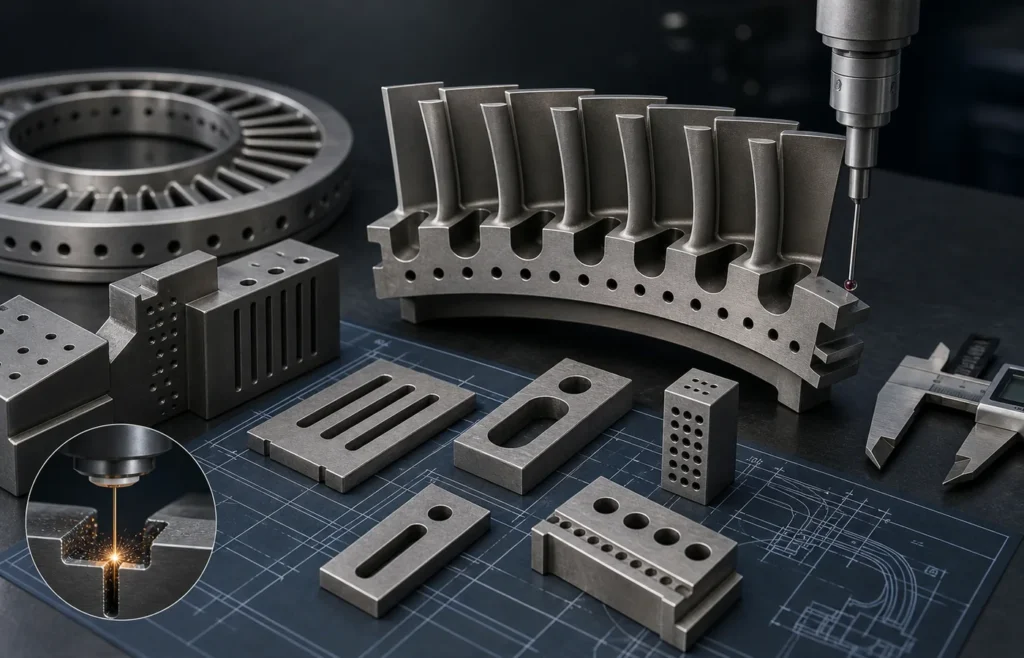
Combustor liners in gas turbine engines typically require thousands of effusion cooling holes, each with diameters often below 1 mm. The quality of these holes directly affects cooling efficiency, component lifespan, and emissions. A recent study published in The Aeronautical Journal by Cambridge University Press investigates how the laser drilling process influences the geometrical and metallurgical characteristics of these critical features.
Effusion Hole Requirements
Effusion holes must meet strict dimensional tolerances while maintaining minimal thermal damage to the surrounding material. Any recast layer, microcracks, or taper can compromise airflow and lead to premature failure. The study focuses on laser drilling, a common alternative to conventional machining and Small Hole EDM Drilling, for producing such holes in nickel-based superalloys.
Laser Drilling vs. Alternative Methods
While laser drilling offers high speed and flexibility, it can introduce heat-affected zones and surface imperfections. The research compares different laser parameters—pulse energy, repetition rate, and focal position—to assess their impact on hole geometry, recast layer thickness, and microstructural changes. Preliminary findings suggest that optimized laser settings can reduce taper and recast layer thickness, bringing hole quality closer to that achieved by electrical discharge machining.
However, the study also notes that laser drilling may still result in higher surface roughness compared to EDM. This trade-off is significant for applications where aerodynamics and thermal barrier coating adhesion are paramount.
Implications for Manufacturing
The results underscore the need for process-specific quality assurance. Manufacturers selecting between laser and EDM methods must consider not only hole geometry but also the metallurgical integrity of the part. The study provides quantitative data to help engineers choose appropriate parameters or hybrid approaches.
For a deeper understanding of small hole capabilities, the Small Hole EDM Diameter Guide offers detailed specifications on achievable tolerances and aspect ratios.
Conclusion
This peer-reviewed research adds valuable evidence to the ongoing evaluation of laser drilling for effusion cooling holes, highlighting both its potential and its limitations when compared to established methods like EDM.
Why This Matters
As gas turbine manufacturers push for higher efficiency and lower emissions, the choice between laser drilling and EDM for effusion holes becomes critical. This study provides data-driven insights that could influence process selection and quality standards across the aerospace industry.