
EDM Service
Titanium Grade 5 Micro EDM Surface Integrity Review for Medical Device Components
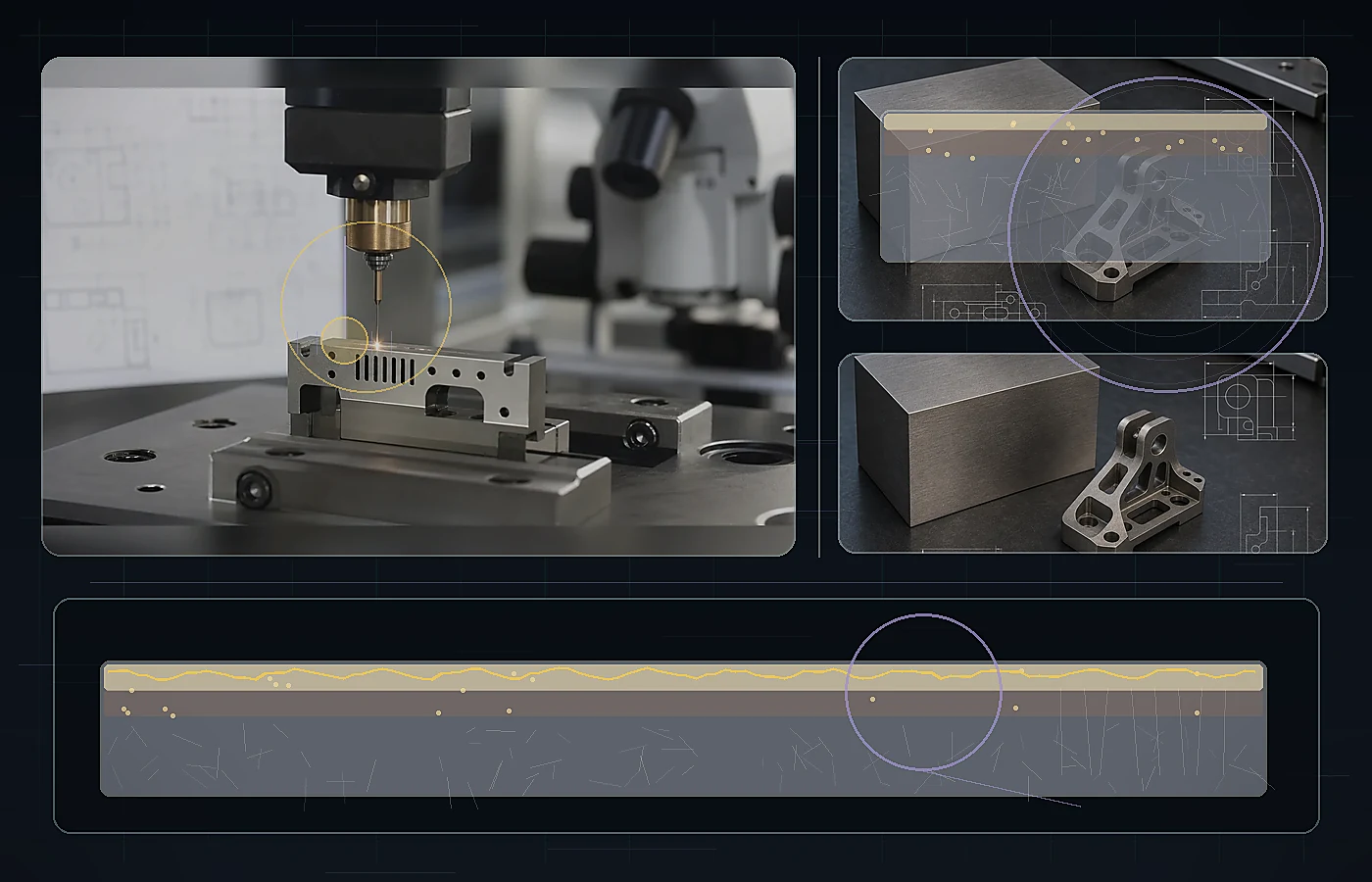
For Medical Device Components, Micro EDM can produce the required conductive features in Titanium Grade 5, but a low Ra value does not approve the surface by itself. Recast, micro-cracks, edge damage, corrosion or fatigue risk, and post-processing must be released as separate requirements.
Quick Answer
For Micro EDM on Titanium Grade 5 in Medical Device Components, approve the functional surface in separate steps. First verify geometry and roughness. Then verify recast or crack acceptance, edge condition, and any corrosion, fatigue, or post-process requirement that the application actually needs.
Key Surface Decisions
Why Surface Integrity Matters Here
The highest application risk is burrs, recast or incomplete documentation on patient-contact, fatigue or cleanable features. A defect on that functional face can shorten service life, compromise the application requirement, or force rejection even when the overall dimensions are correct.
How to Specify Surface Requirements
Define surface acceptance for Medical Device Components by separating roughness, recast, cracks, edge condition, and post-processing. For the Micro EDM feature in Titanium Grade 5, identify critical dimensions, surface finish, burr/recast, documentation, state the exact material condition, and assign an inspection method to each accepted item.
What Gets Missed
The most common acceptance error is releasing the Medical Device Components part from roughness or size alone while recast, edge damage, or sub-surface cracking remains on the named functional face. For Titanium Grade 5, a dimensionally correct feature can still be rejected for recast, contamination, or fatigue-sensitive edge damage. In Micro EDM, the feature can round, drift, or become impossible to verify when electrode wear and measurement resolution consume the tolerance.
Why the Process Affects the Surface
A fine electrode and low-energy pulses remove very small volumes without cutting force. At this scale, electrode wear, gap stability, dielectric access, thermal drift, and optical measurement resolution can be as important as the programmed tool path. For Micro EDM on Titanium Grade 5 in Medical Device Components, the release plan must connect the named functional face to critical dimensions, surface finish, burr/recast, documentation.
Micro EDM Capability Reference
| What you're asking | What you can expect |
|---|---|
| Feature types | micro holes, micro slots, miniature cavities, fine pins, and sub-millimeter precision details |
| Tolerance | ±0.002–0.010 mm |
| Surface finish | Ra 0.1–1.6 μm |
| Feature scale | Sub-millimeter holes, slots, and cavities |
| Primary micro limit | Electrode wear and measurement resolution |
| Main limitation | Loose-tolerance or easily accessible features are rarely economical with Micro EDM. |
Medical Device Components Surface Planning
| What matters | What to expect |
|---|---|
| Typical parts | precision instrument parts, medical tooling, micro features, and assembly and inspection fixtures |
| Functional requirement | small precise features, controlled edges, surface-integrity requirements and material traceability |
| Main failure risk | burrs, recast or incomplete documentation on patient-contact, fatigue or cleanable features |
| Inspection focus | critical dimensions, surface finish, burr/recast, documentation |
Material Condition Reference
| Condition | What to expect | Watch out for | Surface notes |
|---|---|---|---|
| annealed | Use stable support and low-energy finishing. | Thermal surface effects can reduce fatigue resistance. | Specify recast and edge condition on fatigue and medical faces. |
| stress-relieved | Plan around stress relief and thin-wall movement. | Residual stress can distort delicate profiles. | Use trim passes and controlled post-processing on critical faces. |
Application and Material Context
Titanium Grade 5 is the common Ti-6Al-4V alpha-beta alloy whose annealed or heat-treated state changes strength and residual stress. In Micro EDM for Medical Device Components, limit aggressive energy on fatigue faces, control recast or contamination, and keep post-process cleanliness explicit. The material condition affects the acceptance route, but it is not itself a substitute for application-specific surface criteria.
Functional Surface-Integrity Requirements
For Micro EDM on Titanium Grade 5 in Medical Device Components, use separate acceptance statements: roughness for texture, recast for the resolidified layer, crack inspection where fatigue or brittleness matters, edge inspection for rollover or chipping, and corrosion or post-process verification where service requires it. Evaluate critical dimensions, surface finish, burr/recast, documentation from the correct datum.
Medical Device Components Surface Checkpoints
- State the exact Titanium Grade 5 condition and identify the Micro EDM features.
- Mark the functional faces and specify roughness, recast, edge, corrosion, fatigue, passivation, or post-process limits separately.
- Define how critical dimensions, surface finish, burr/recast, and documentation will be inspected before batch release.
Limits and Better Alternatives
Main Limit
A low Ra value cannot by itself approve the Titanium Grade 5 Micro EDM surface for Medical Device Components.
Consider Another Route When
Use conventional EDM for larger features, precision laser processing for suitable thin geometry, or mechanical micro-drilling where a tool can reach.
Practical Next Step
Send the Medical Device Components drawing with the Titanium Grade 5 condition, Micro EDM features, functional faces, roughness target, recast or edge limits, quantity, and the method used to inspect critical dimensions, surface finish, burr/recast, documentation.
Practical Takeaway
For Medical Device Components in Titanium Grade 5, Ra is only one part of Micro EDM surface approval. Release the affected layer, material risk, post-process, and functional inspection separately.
Additional Project Information
Include application, destination and end-use notes together with the material, quantity and drawing requirements.
Project Details for Technical Review
Include application and end-use notes when they affect material, inspection, documentation, or export review.
- Process: Micro EDM
- Material: Titanium Grade 5
- Application: Medical Device Components
- Drawing or part sketch
- Material grade
- Thickness / part size
- Quantity
- Tolerance and critical dimensions
- Surface finish or inspection requirement
STEP/STP, DXF, DWG, PDF, IGS/IGES or ZIP.
Confidential drawing review. NDA support available on request.
Frequently Asked Questions
Is a low Ra value enough to approve this Micro EDM surface?
No. Roughness, recast, edge damage, corrosion or fatigue risk, and post-processing are separate acceptance items. On Titanium Grade 5, the supplied condition and functional faces must also be identified before finish energy is selected.
Why use Micro EDM for Medical Device Components in Titanium Grade 5?
Use it when the feature is a micro hole, micro slot, miniature cavity, fine pin, or other sub-millimeter detail and the process supports small precise features, controlled edges, surface-integrity requirements and material traceability. The route is selected from the feature, not from the industry or material name alone.
How does the condition of Titanium Grade 5 affect surface planning?
The condition changes dimensional stability, recast behavior, residual stress, corrosion or fatigue response, and post-process needs. Fatigue-critical edges and low thermal conductivity require low-energy finish planning.
What should be inspected after machining?
Inspect roughness, recast, micro-cracks, edge condition, corrosion or fatigue risk, post-processing, critical dimensions, surface finish, burr/recast, and documentation separately on the functional faces. Add passivation or batch-repeatability checks where the drawing requires them.