
Technical Reference
EDM White Layer Guide Technical Reference
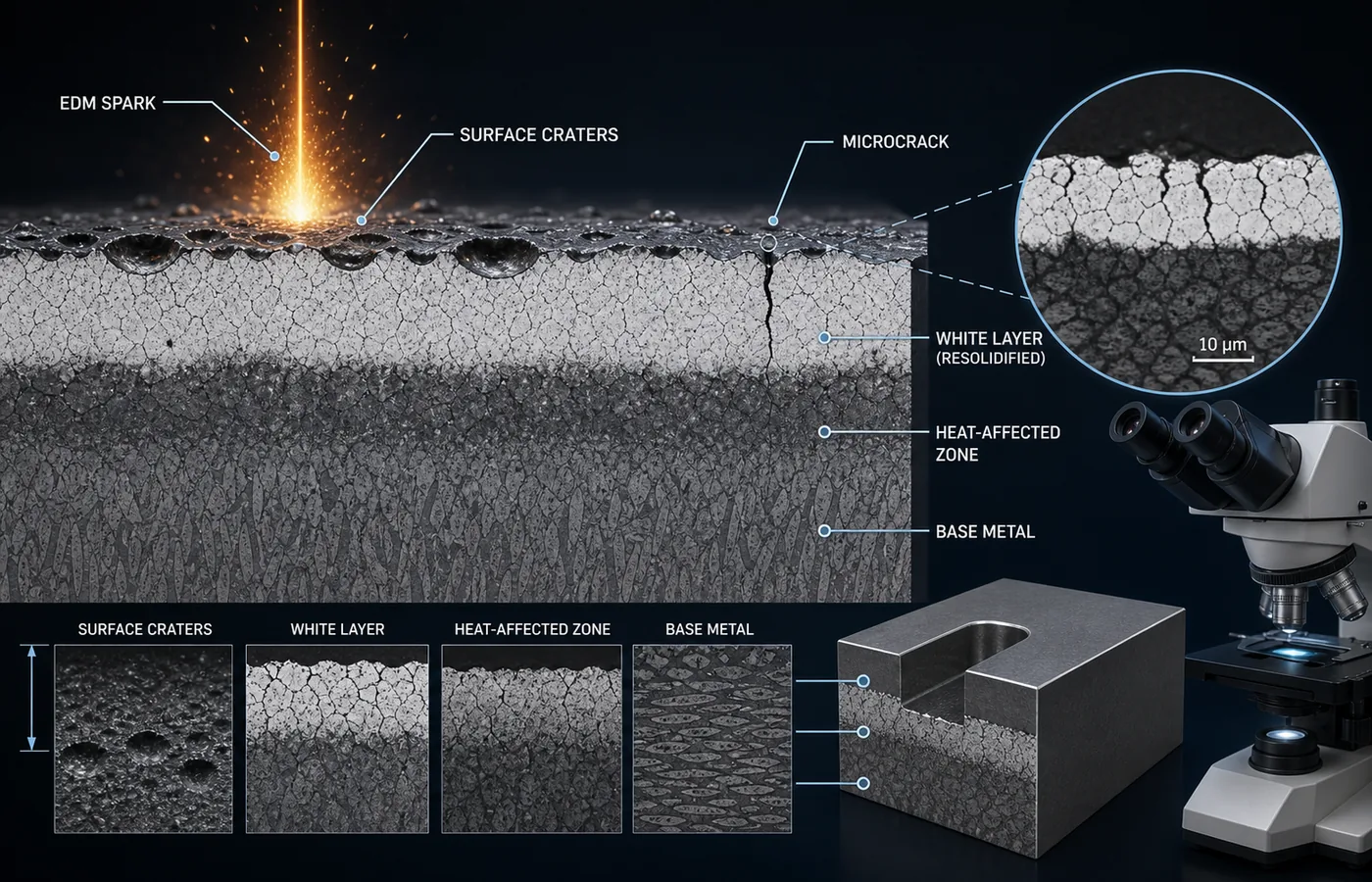
The white layer is the visible or metallographically observed resolidified EDM surface; its thickness and continuity vary with energy, material, flushing, and finishing. White layer can be hard, brittle, cracked, and chemically different from the base material even when the surface looks smooth.
Quick Answer
The white layer is the visible or metallographically observed resolidified EDM surface; its thickness and continuity vary with energy, material, flushing, and finishing.
Key Surface Points
What the Surface Requirement Means
Assuming every white layer is harmless—or that every part needs complete removal—creates either performance risk or unnecessary cost. The consequence changes fit, function, or service performance for the White Layer decision; it is not only a change in surface appearance.
How to Control It
Separate white-layer acceptance from roughness and mark the functional faces that need a limit, removal, or post-process. When planning White Layer, apply the requirement only to the dimensions and faces that control fit, function, service life, or documented release.
What Gets Missed
White layer can be hard, brittle, cracked, and chemically different from the base material even when the surface looks smooth. Fatigue or wear faces need a separate thickness or removal rule and a matching verification method.
Technical Context
White layer is the metallographically bright, rapidly resolidified surface zone often associated with EDM on steels. It differs from the tempered base material in microstructure and hardness. Its presence, thickness, and crack condition should be controlled only where service performance requires it. This mechanism explains the limits and behavior that matter when planning White Layer.
EDM White Layer Guide Reference
| What you're asking | What you can expect |
|---|---|
| Acceptance item | Define separately |
| Roughness | Ra and measurement method |
| Recast/white layer | limit or removal on named face |
| Microcracks | method, magnification, and acceptance |
| Edge | radius, break, chipping, or rollover |
| Post-process | polish, lap, grind, stress relief, or passivation |
Inspection and Post-Process
On steel, treat white-layer thickness, continuity, cracking, and any removal allowance as separate decisions. A polished surface can still contain an affected layer below the visible texture. For White Layer, tie the accepted condition to the feature and inspection method named in the drawing.
White Layer Drawing and Release Checkpoints
- Identify the controlled feature, material condition, access direction, and functional datum for this White Layer decision.
- Separate dimensional requirements from texture, edge, recast, corrosion, fatigue, or post-process acceptance.
- State the inspection method, sampling or first-article requirement, drawing revision, quantity, and any documentation needed for release.
Limits and Better Alternatives
Main Limit
For EDM White Layer Guide, one Ra value cannot approve recast, micro-cracks, edge damage, corrosion response, fatigue risk, or post-processing. When that boundary dominates, use lower-energy finishing, selective polishing/lapping/grinding, or a process redesign where the functional surface cannot accept the EDM-affected condition.
Consider Another Route When
Use lower-energy finishing, selective polishing/lapping/grinding, or a process redesign where the functional surface cannot accept the EDM-affected condition.
Practical Next Step
On steel, treat white-layer thickness, continuity, cracking, and any removal allowance as separate decisions. Separate white-layer acceptance from roughness and mark the functional faces that need a limit, removal, or post-process.
What to Remember
The white layer is the visible or metallographically observed resolidified EDM surface; its thickness and continuity vary with energy, material, flushing, and finishing. A surface is accepted by the failure mode it must prevent, not by one roughness value applied to the whole part.
Technical Reference
Use the values as planning references and define the functional requirement on the controlled drawing.
Use This Guide to Prepare Your RFQ
Contact us when your drawing and requirements are ready for review.
- Drawing or part sketch
- Material grade
- Thickness / part size
- Quantity
STEP/STP, DXF, DWG, PDF, IGS/IGES or ZIP.
Confidential drawing review. NDA support available on request.
Frequently Asked Questions
Is Ra enough to approve the surface?
No. Roughness and metallurgical/edge condition are separate.
Which faces need detailed control?
Fatigue, seal, wear, corrosion, contact, cutting, and medical surfaces.
Can finishing reduce the affected layer?
Yes, but the pass or removal method and inspection must be defined.
Should every surface use the same requirement?
No. Restrict detailed acceptance to functional faces.