
Technical Reference
EDM Recast Layer Guide Technical Reference
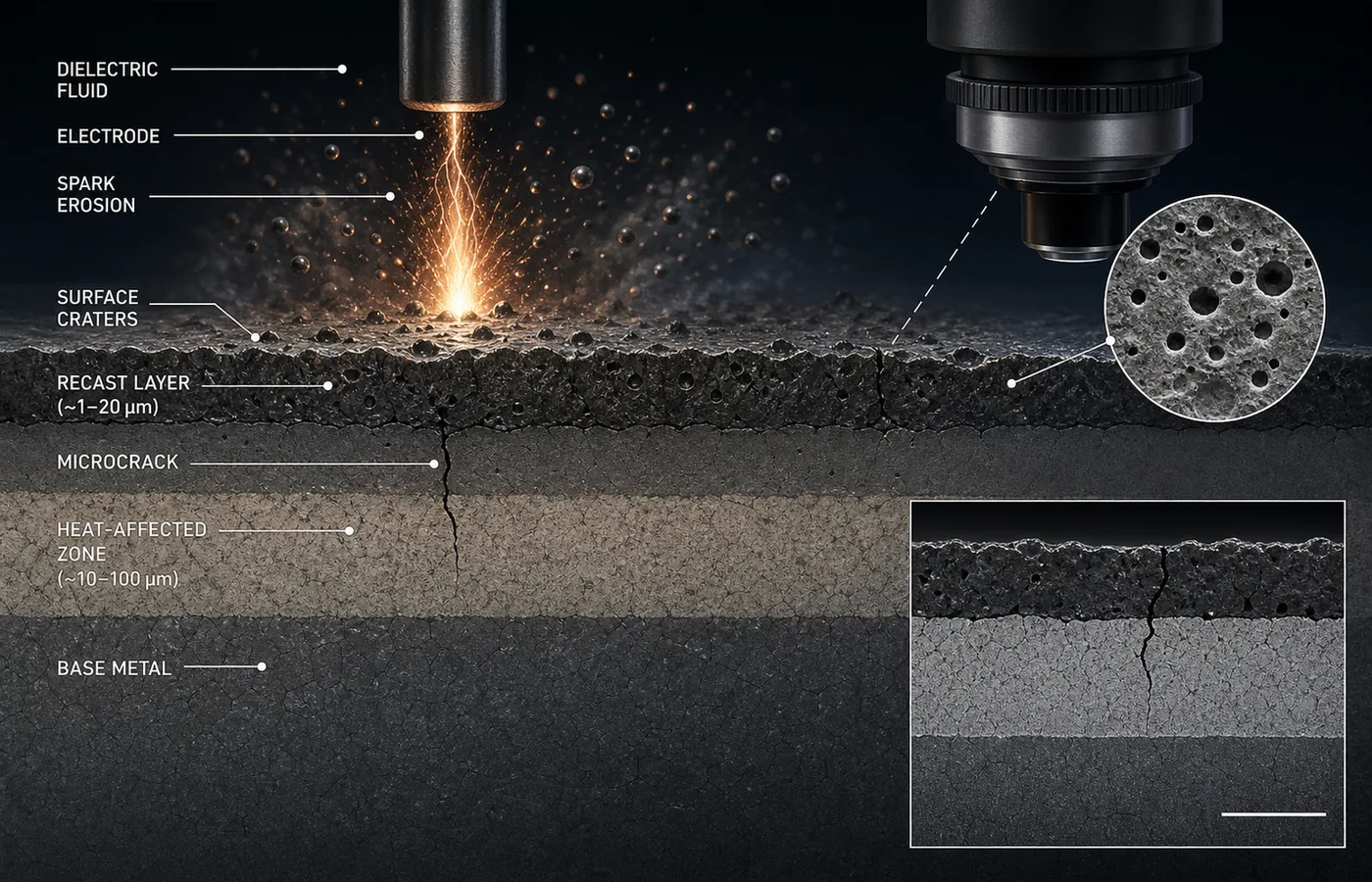
A usable recast callout must tell the supplier exactly where the requirement applies, how much layer may remain, how compliance is verified, and what dimension must remain after removal. This is the drawing and acceptance reference.
Quick Answer
For a detailed recast-layer requirement, identify the functional face, maximum affected-layer condition, sampling location, removal allowance, and the dimensional check after removal.
Key Surface Points
What the Surface Requirement Means
Writing “remove recast” without a face, depth, method, or remaining allowance creates an uninspectable requirement. The consequence changes fit, function, or service performance for the Recast Layer decision; it is not only a change in surface appearance.
How to Control It
Choose a numerical layer limit or complete removal for each named face, then define the removal or verification method, sampling location and frequency, and final dimensional check.
What Gets Missed
Writing “remove recast” without a face, depth, method, sampling rule, or remaining dimensional allowance creates an uninspectable requirement. The part can be over-polished, left with residual layer, or moved out of tolerance after removal while every supplier claims to have followed the note.
Technical Context
A drawing-ready recast requirement needs five elements: the affected face, the maximum allowed recast thickness or complete-removal requirement, the removal or verification method, the sampling location and frequency, and the dimensional check after removal. Writing only “remove recast” cannot be quoted or inspected consistently because one supplier may polish a few micrometers while another removes far more stock. This guide is the release and acceptance reference for documenting those five elements.
Five Elements of a Recast Callout
| Drawing element | What to state | Why it is needed |
|---|---|---|
| Face | Named surface, edge, wall, or floor | Prevents the note from applying to the whole part |
| Depth | Maximum layer thickness or complete removal | Creates a measurable acceptance limit |
| Method | Polish, lap, grind, etch, skim, or verification route | Controls how compliance is achieved |
| Sampling | Location, quantity, and frequency | Makes destructive or batch inspection repeatable |
| Post-removal dimension | Final size and datum after stock removal | Prevents the surface process from breaking tolerance |
Inspection and Post-Process
Record the inspection result against the named face and drawing revision. When verification is destructive, define the sample location and batch frequency before cutting; when removal is used, re-check the controlled dimension afterward.
Recast Drawing and Acceptance Checkpoints
- Name every controlled face and state the maximum recast thickness or complete-removal rule.
- Define the removal or verification method plus sampling location and frequency.
- Re-check the controlled dimension after removal and record the inspection result against the drawing revision.
Limits and Better Alternatives
Main Limit
A recast specification is only as strong as its five elements. Missing face, depth, method, sampling, or post-removal dimension creates a requirement that cannot be quoted and released consistently.
Consider Another Route When
Use lower-energy finishing, selective polishing/lapping/grinding, or a process redesign where the functional surface cannot accept the EDM-affected condition.
Practical Next Step
Write the five elements—face, depth, method, sampling, and post-removal dimension—before releasing the drawing for quotation.
What to Remember
A recast note becomes enforceable only when all five release elements are stated and tied to the final dimensional inspection.
Technical Reference
Use the values as planning references and define the functional requirement on the controlled drawing.
Use This Guide to Prepare Your RFQ
Contact us when your drawing and requirements are ready for review.
- Drawing or part sketch
- Material grade
- Thickness / part size
- Quantity
STEP/STP, DXF, DWG, PDF, IGS/IGES or ZIP.
Confidential drawing review. NDA support available on request.
Frequently Asked Questions
Why is “remove recast” not enough on a drawing?
It does not identify the face, allowed depth, removal amount, verification method, sampling, or dimensional re-check. Different suppliers can comply in incompatible ways.
What should a recast specification include?
Name the functional face, maximum allowed thickness or complete removal, removal or verification method, sampling location and frequency, and dimensional re-check after removal.
How is recast removal verified?
Metallographic cross-sectioning is definitive but destructive. Other agreed methods can combine microscopy, microhardness, roughness, and process evidence; the inspection plan must be defined before cutting.
Can skim cuts eliminate the need for a recast specification?
Not automatically. Low-energy passes can reduce the layer, but the remaining condition depends on material and pass count. Fatigue-critical applications still need an explicit acceptance method.