
Technical Reference
Wire EDM Vs Sinker EDM
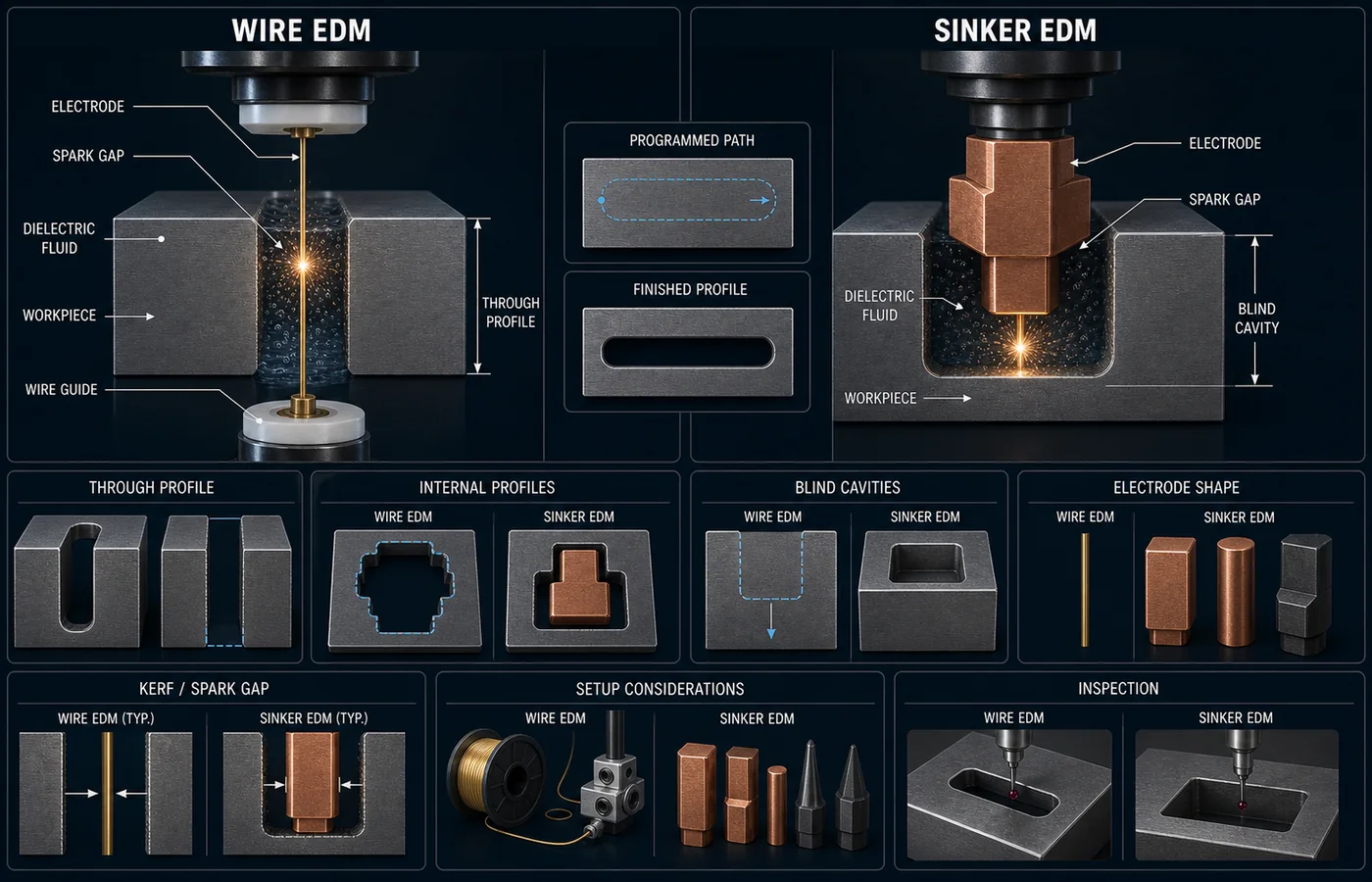
Wire EDM and Sinker EDM solve different access problems: moving wire for through profiles, shaped electrodes for blind cavities. One part can legitimately use both processes: Wire EDM for through slots and cutouts, then Sinker EDM for blind pockets, ribs, or internal forms.
Quick Answer
Wire EDM and Sinker EDM solve different access problems: moving wire for through profiles, shaped electrodes for blind cavities.
Comparison Summary
Choose the First Route When
Choose Sinker EDM for blind pockets, ribs, mold cavities, and internal forms; a hybrid route is normal when one part contains both. The consequence changes fit, function, or service performance for the wire EDM vs. sinker EDM decision; it is not only a change in surface appearance.
Choose the Second Route When
Choose Wire EDM for slots, punches, cutouts, and through contours where the wire can pass completely through the workpiece. When planning wire EDM vs. sinker EDM, apply the requirement only to the dimensions and faces that control fit, function, service life, or documented release.
Where a Hybrid Route Works
One part can legitimately use both processes: Wire EDM for through slots and cutouts, then Sinker EDM for blind pockets, ribs, or internal forms. The common mistake is forcing one process onto geometry that it cannot physically access.
How the Processes Differ
Wire EDM cuts through profiles with a continuously moving wire—like a precision saw that can turn any corner the wire can pass through. Sinker EDM burns blind cavities with a shaped electrode—like a stamp that erodes its own shape into the workpiece. Wire cannot make blind features, and Sinker cannot replace a continuous wire path economically on open through profiles. Many hardened parts use both: Wire cuts the outer profile and through slots, while Sinker forms blind pockets, ribs, and cavity details.
Wire EDM Conditional Planning
| Condition or input | What changes | What must be confirmed |
|---|---|---|
| through profile or slot | Defines whether the process access is valid | wire diameter, kerf compensation, flushing, wire tension, guide alignment, taper, and trim-pass stability |
| Material condition | Changes support, wear, stability, and surface response | Exact grade, condition, and functional faces |
| Depth or section height | Changes flushing, wear, deflection, or metrology | True feature depth, aspect ratio, datum, and inspection |
| Finish stage | Changes texture and final size together | Rough/finish sequence and allowance |
wire EDM vs. sinker EDM Drawing and Release Checkpoints
- Identify the controlled feature, material condition, access direction, and functional datum for this wire EDM vs. sinker EDM decision.
- Separate dimensional requirements from texture, edge, recast, corrosion, fatigue, or post-process acceptance.
- State the inspection method, sampling or first-article requirement, drawing revision, quantity, and any documentation needed for release.
Limits and Better Alternatives
Main Limit
For wire EDM vs. sinker EDM, a process comparison does not select one route for the entire part; different features may need different processes. When that boundary dominates, use CNC for open accessible geometry and keep EDM only on the features that need its access, hardness independence, or edge quality.
Consider Another Route When
Use CNC for open accessible geometry and keep EDM only on the features that need its access, hardness independence, or edge quality.
Practical Next Step
Inspect entry and exit edges, verticality, wire-break marks, and the functional cut faces. Choose Wire EDM for slots, punches, cutouts, and through contours where the wire can pass completely through the workpiece.
What to Remember
Wire EDM and Sinker EDM solve different access problems: moving wire for through profiles, shaped electrodes for blind cavities. Assign each feature to the process that can reach it economically and meet the required edge, tolerance, finish, and inspection.
Need Help Reviewing an EDM Drawing?
Send a question or drawing for a compact technical review.
- Drawing or part sketch
- Material grade
- Thickness / part size
- Quantity
STEP/STP, DXF, DWG, PDF, IGS/IGES or ZIP.
Confidential drawing review. NDA support available on request.
Frequently Asked Questions
Which process handles through profiles?
Wire EDM.
Which process handles blind cavities?
Sinker EDM.
Can both be used on one part?
Yes. Profiles and blind forms are often split between the two.
Which process avoids electrode manufacturing?
Wire EDM uses standard wire; Sinker EDM normally needs shaped electrodes.