Technical Reference
EDM Vs Waterjet Cutting Technical Reference
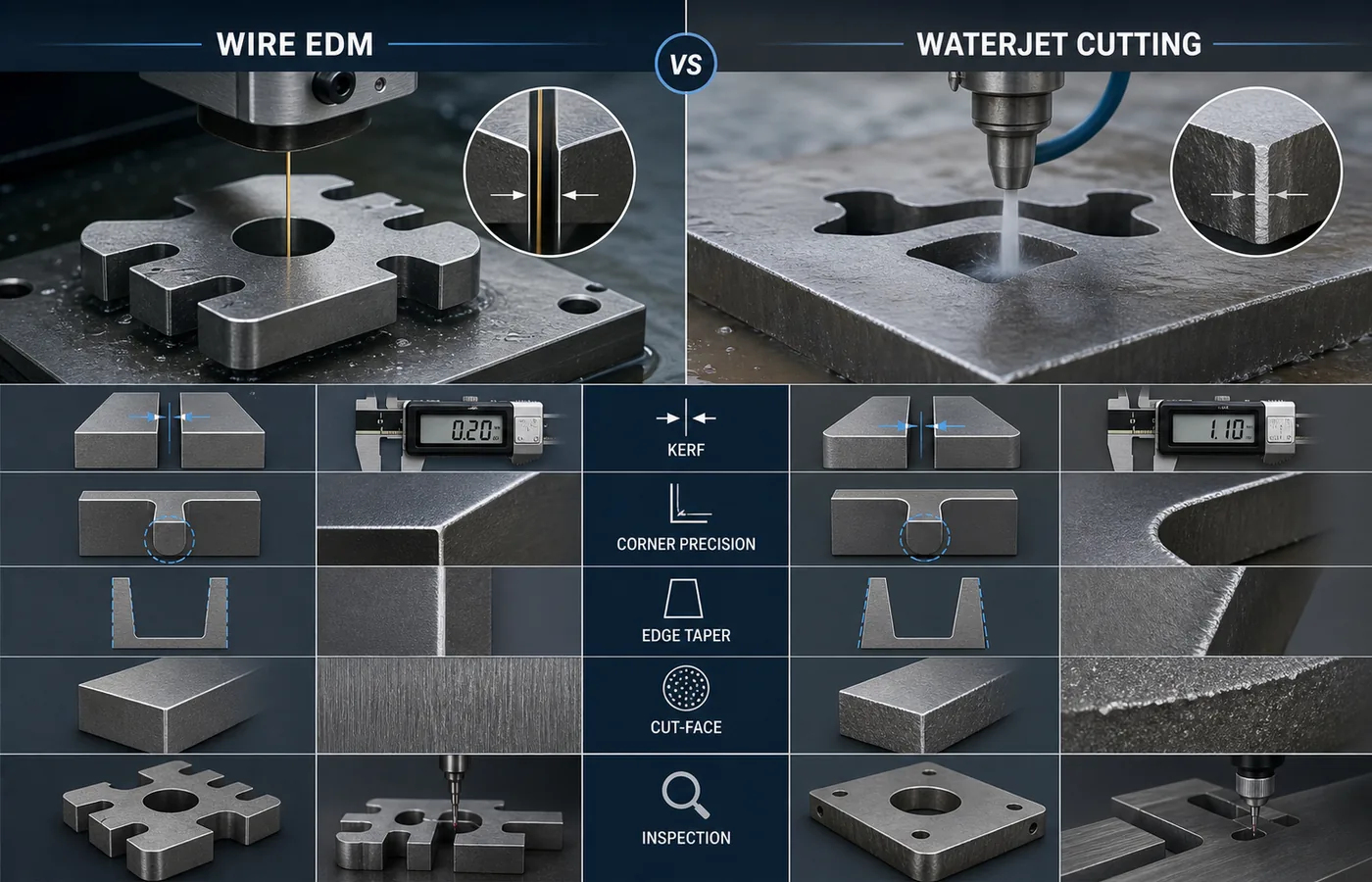
Choosing between EDM and waterjet cutting means comparing precision and feature detail against material range and cutting speed. Waterjet handles large or nonconductive profiles; EDM takes over where conductive features need tighter geometry, cleaner edges, or smaller internal detail.
Quick Answer
EDM offers tighter detail and hardness independence; waterjet cuts a much wider material range without a heat-affected zone.
Comparison Summary
Choose the First Route When
Choose waterjet for thick plate, nonconductive material, large outlines, and fast rough profiles where kerf taper and a wider tolerance are acceptable. The consequence changes fit, function, or service performance for the EDM vs Waterjet Cutting decision; it is not only a change in surface appearance.
Choose the Second Route When
Choose EDM for conductive precision profiles, blind forms, small holes, or edge requirements beyond ordinary waterjet capability. When planning EDM vs Waterjet Cutting, apply the requirement only to the dimensions and faces that control fit, function, service life, or documented release.
Where a Hybrid Route Works
A hybrid route can waterjet the large outline or rough blank, then use EDM for the conductive precision features, narrow slots, datum details, or hardened edges. Leave controlled stock on the EDM faces and reference both operations from the same datum.
How the Processes Differ
Waterjet removes material by high-pressure abrasive erosion and can cut metals, composites, ceramics, and other nonconductive materials. EDM removes only conductive material with electrical discharges, but it can hold smaller internal details, tighter kerf control, and cleaner precision edges on hardened parts. Waterjet is the better rough-profile process for large or mixed materials; EDM is the finishing process when the conductive feature needs narrow slots, sharp internal geometry, or tighter datum control.
EDM vs Waterjet Cutting Reference
| Factor | EDM | Waterjet |
|---|---|---|
| Material | conductive material | metals and many nonmetals |
| Heat-affected zone | thermal EDM layer | none from cutting heat |
| Typical precision | higher | lower; machine and thickness dependent |
| Edge | fine EDM texture | striations and taper possible |
| Best use | critical features | large blanks and broad profiles |
EDM vs Waterjet Cutting: Drawing and Release Checkpoints
- Identify the controlled feature, material condition, access direction, and functional datum for this EDM vs Waterjet Cutting decision.
- Separate dimensional requirements from texture, edge, recast, corrosion, fatigue, or post-process acceptance.
- State the inspection method, sampling or first-article requirement, drawing revision, quantity, and any documentation needed for release.
Limits and Better Alternatives
Main Limit
For EDM vs Waterjet Cutting, a process comparison does not select one route for the entire part; different features may need different processes. When that boundary dominates, use waterjet for the blank and EDM for the critical features, datums, corners, or hardened profiles.
Consider Another Route When
Use waterjet for the blank and EDM for the critical features, datums, corners, or hardened profiles.
Practical Next Step
Assign surface, edge, and sub-surface requirements only where they affect function, and give each requirement its own acceptance method. Choose EDM for conductive precision profiles, blind forms, small holes, or edge requirements beyond ordinary waterjet capability.
What to Remember
EDM offers tighter detail and hardness independence; waterjet cuts a much wider material range without a heat-affected zone. A comparison is complete when each feature has a justified process route and both routes share the same datum and release criteria.
Technical Reference
Use the values as planning references and define the functional requirement on the controlled drawing.
Use This Guide to Prepare Your RFQ
Contact us when your drawing and requirements are ready for review.
- Drawing or part sketch
- Material grade
- Thickness / part size
- Quantity
STEP/STP, DXF, DWG, PDF, IGS/IGES or ZIP.
Confidential drawing review. NDA support available on request.
Frequently Asked Questions
When is waterjet better?
For large outlines, thick plate, nonconductive materials, or rough blanks.
When is EDM better?
For tight conductive features, hardened parts, small radii, and controlled edges.
Does waterjet create heat damage?
It is a cold cutting process, although taper and striation still need review.
Can the processes be combined?
Yes. Waterjet can remove the blank before EDM finishes critical geometry.