
Technical Reference
Wire EDM Surface Finish Guide Technical Reference
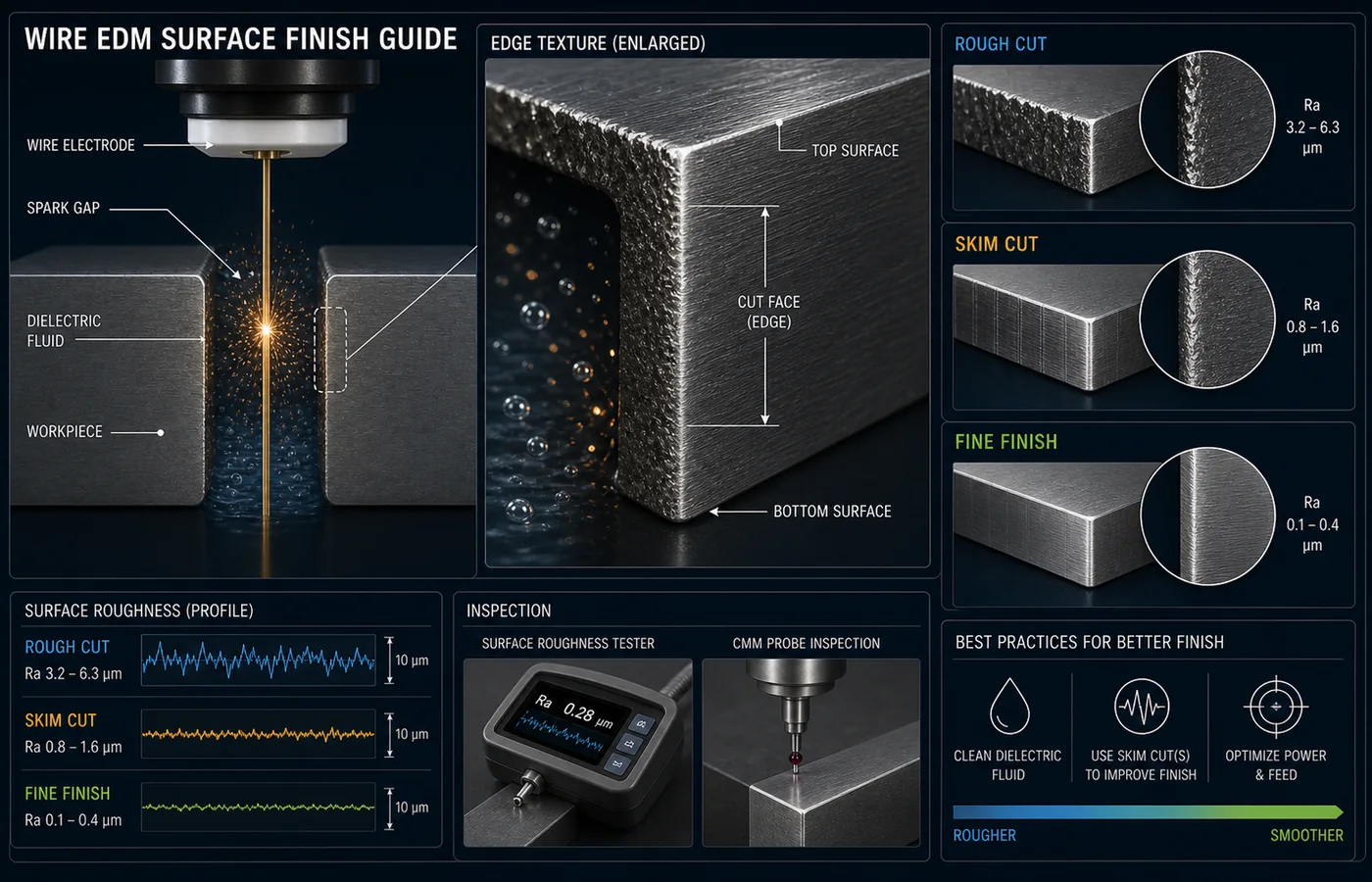
Wire EDM finish improves as discharge energy is reduced through one or more trim passes after the rough profile is established. Wire EDM finish changes with rough cut, trim-pass count, section height, flushing, and wire condition.
Quick Answer
Wire EDM finish improves as discharge energy is reduced through one or more trim passes after the rough profile is established.
Key Surface Points
What the Surface Requirement Means
Each trim pass adds cycle time and changes the final profile; one pass should not be assumed to deliver Ra 0.4 μm on every job. The consequence changes fit, function, or service performance for the Wire EDM Surface Finish decision; it is not only a change in surface appearance.
How to Control It
Select trim-pass count from the functional Ra target, section height, material, profile stability, and final offset. When planning Wire EDM Surface Finish, apply the requirement only to the dimensions and faces that control fit, function, service life, or documented release.
What Gets Missed
Wire EDM finish changes with rough cut, trim-pass count, section height, flushing, and wire condition. A smooth top edge does not prove the full cut face, bottom profile, recast condition, or verticality is acceptable.
Technical Context
EDM texture is formed by overlapping discharge craters. Higher-energy roughing creates larger craters and faster removal; lower-energy finishing and additional passes reduce crater size but add time and can alter the final profile offset or cavity size. This mechanism explains the limits and behavior that matter when planning Wire EDM Surface Finish.
Finish Planning by Pass Strategy
| Stage / condition | Primary purpose | What changes with the stage |
|---|---|---|
| Roughing | open the geometry efficiently | larger discharge craters, faster removal, more allowance for size correction |
| Finishing / skim | reduce texture and correct size | lower energy, corrected offset or orbit, more time and higher stability demand |
| Post-finish | polish, lap, grind, or chemically treat selected faces | changes the final dimension and must be included in the datum and allowance plan |
Inspection and Post-Process
Separate the texture target from recast, edge condition, and post-processing. A lower Ra usually requires lower-energy passes and more time, but it does not automatically remove the metallurgical layer. For Wire EDM Surface Finish, tie the accepted condition to the feature and inspection method named in the drawing.
Wire EDM Surface Finish Drawing and Release Checkpoints
- Identify the controlled feature, material condition, access direction, and functional datum for this Wire EDM Surface Finish decision.
- Separate dimensional requirements from texture, edge, recast, corrosion, fatigue, or post-process acceptance.
- State the inspection method, sampling or first-article requirement, drawing revision, quantity, and any documentation needed for release.
Limits and Better Alternatives
Main Limit
For Wire EDM Surface Finish Guide, one Ra value cannot approve recast, micro-cracks, edge damage, corrosion response, fatigue risk, or post-processing. When that boundary dominates, use polishing or lapping on accessible faces, relax nonfunctional surfaces, or reserve additional trims for the critical profile only.
Consider Another Route When
Use polishing or lapping on accessible faces, relax nonfunctional surfaces, or reserve additional trims for the critical profile only.
Practical Next Step
Separate the texture target from recast, edge condition, and post-processing. Select trim-pass count from the functional Ra target, section height, material, profile stability, and final offset.
What to Remember
Wire EDM finish improves as discharge energy is reduced through one or more trim passes after the rough profile is established. Release roughness, recast, cracks, edge condition, and post-processing as separate requirements wherever function demands it.
Technical Reference
Use the values as planning references and define the functional requirement on the controlled drawing.
Use This Guide to Prepare Your RFQ
Contact us when your drawing and requirements are ready for review.
- Drawing or part sketch
- Material grade
- Thickness / part size
- Quantity
STEP/STP, DXF, DWG, PDF, IGS/IGES or ZIP.
Confidential drawing review. NDA support available on request.
Frequently Asked Questions
How many trim passes are needed?
The count follows material, height, profile stability, and the specified Ra.
Does a trim pass change size?
Yes. Offset and final dimensions must be planned with the finish pass.
Should every cut face be finely finished?
No. Apply extra trims only to functional faces or profiles.
Does fine Ra remove all recast?
No. Recast and roughness need separate acceptance rules.