
Technical Reference
EDM For Aluminum Technical Reference
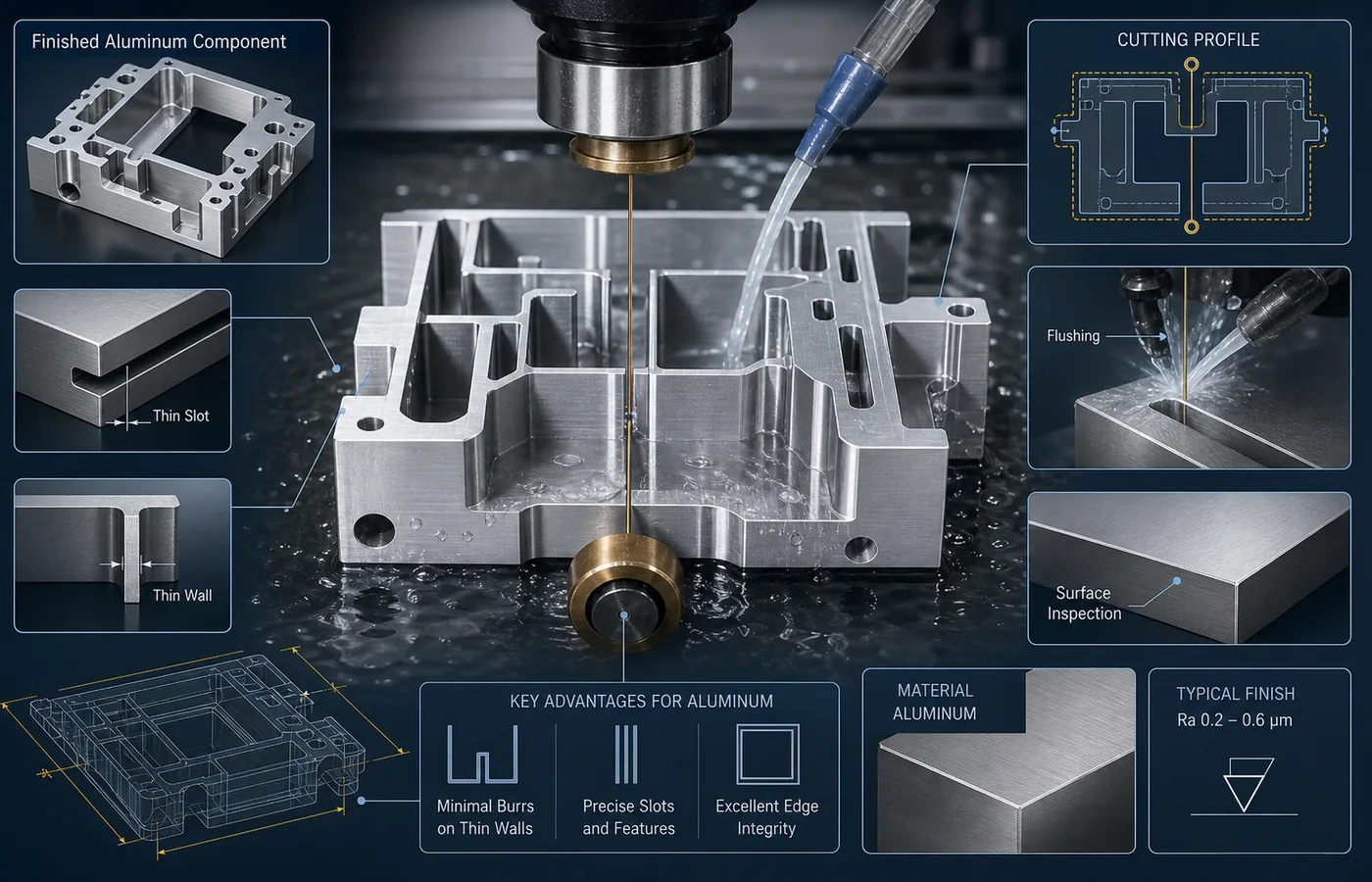
Aluminum alloys cut efficiently by EDM, but high conductivity, soft edges, oxide, distortion, and corrosion protection affect setup and finishing. Aluminum risk usually appears after the cut: soft edges can mark, thin sections can move as residual stress is released, and fresh EDM faces can oxidize or corrode.
Quick Answer
Aluminum alloys cut efficiently by EDM, but high conductivity, soft edges, oxide, distortion, and corrosion protection affect setup and finishing.
Key Material Points
Material Behavior
Soft stock can mark or move, and high flushing or heat input can disturb thin walls even without mechanical cutting force. The consequence changes fit, function, or service performance for the Aluminum decision; it is not only a change in surface appearance.
Process Fit
State alloy and temper; support thin sections gently and reserve fine finishing for functional profiles or surfaces. When planning Aluminum, apply the requirement only to the dimensions and faces that control fit, function, service life, or documented release.
Risks to Manage
Aluminum risk usually appears after the cut: soft edges can mark, thin sections can move as residual stress is released, and fresh EDM faces can oxidize or corrode. Support, handling, and surface protection must be planned with the machining route.
How the Material Responds
Aluminum has high thermal conductivity and pulls heat away from the discharge zone faster than steel. Higher energy may be needed to keep the gap stable, but excess energy rounds soft edges and widens the effective gap. Moderate energy with strong but non-deflecting flushing is usually the practical balance. Fresh aluminum faces oxidize quickly, and copper-bearing grades such as 2024 are more vulnerable to galvanic staining or pitting if dielectric residue remains. Clean, dry, and protect exposed cut faces promptly.
Grade and Condition Comparison
| Condition or material | Best fit | Main EDM planning concern |
|---|---|---|
| 6061-T6 | stable general-purpose choice for fixtures and open features | soft edges and clamping marks on thin sections |
| 7075-T6 | higher-strength aerospace and fixture parts | residual-stress release can move thin sections |
| 2024-T3 | high-strength copper-bearing aerospace parts | corrosion protection and thin-edge support are important |
| A356 cast aluminum | cast shapes and prototypes | porosity can make fine functional surfaces inconsistent |
Condition and Process Behavior
Aluminum cuts quickly with conventional tools on open geometry, so EDM adds value mainly at inaccessible corners, burr-sensitive thin edges, deep small holes, or heat-treated features that cannot tolerate cutting force. High conductivity affects discharge stability, while soft edges and residual stress make support and handling decisive. Use gentle fixturing, controlled flushing, and prompt surface protection.
Surface Integrity
For this material family, surface acceptance follows the exact grade and condition. Separate roughness from corrosion, passivation, fatigue, contact, or post-process requirements on the functional faces. For Aluminum, tie the accepted condition to the feature and inspection method named in the drawing.
Aluminum Drawing and Release Checkpoints
- Identify the controlled feature, material condition, access direction, and functional datum for this Aluminum decision.
- Separate dimensional requirements from texture, edge, recast, corrosion, fatigue, or post-process acceptance.
- State the inspection method, sampling or first-article requirement, drawing revision, quantity, and any documentation needed for release.
Limits and Better Alternatives
Main Limit
Aluminum is easy to machine conventionally on open geometry, so EDM is normally reserved for inaccessible corners, burr-sensitive thin edges, deep small holes, or features that cannot tolerate cutting force. Soft support, distortion, oxidation, and handling can limit the result before spark power does.
Practical Next Step
For this material family, surface acceptance follows the exact grade and condition. State alloy and temper; support thin sections gently and reserve fine finishing for functional profiles or surfaces.
What to Remember
Aluminum alloys cut efficiently by EDM, but high conductivity, soft edges, oxide, distortion, and corrosion protection affect setup and finishing. Material-family guidance becomes actionable only after grade, state, functional face, and post-process acceptance are fixed.
Technical Reference
Use the values as planning references and define the functional requirement on the controlled drawing.
Use This Guide to Prepare Your RFQ
Contact us when your drawing and requirements are ready for review.
- Drawing or part sketch
- Material grade
- Thickness / part size
- Quantity
STEP/STP, DXF, DWG, PDF, IGS/IGES or ZIP.
Confidential drawing review. NDA support available on request.
Frequently Asked Questions
Does aluminum cut faster than steel in EDM?
It can remove material quickly, but high thermal conductivity pulls heat out of the gap and may require more discharge energy for stable cutting. Excess energy rounds soft edges, so speed and edge control must be balanced.
Why can 2024 aluminum corrode after EDM?
2024 contains copper-rich phases. EDM exposes fresh cut metal and grain boundaries; dielectric residue or humidity can start galvanic staining or pitting. Clean and protect the surface promptly after machining.
Can 6061 and 2024 use the same EDM settings?
Not without adjustment. 6061 is generally more forgiving, while 2024 is more corrosion-sensitive and can round at fragile edges under the same energy. Tune energy, flushing, and handling to the exact grade and temper.
Does aluminum need recast removal?
Not on every surface. It becomes important on seal faces, coating or anodizing surfaces, fatigue-sensitive edges, or any face where the recast layer can affect adhesion or function.