
Technical Reference
EDM Material Compatibility Guide Technical Reference
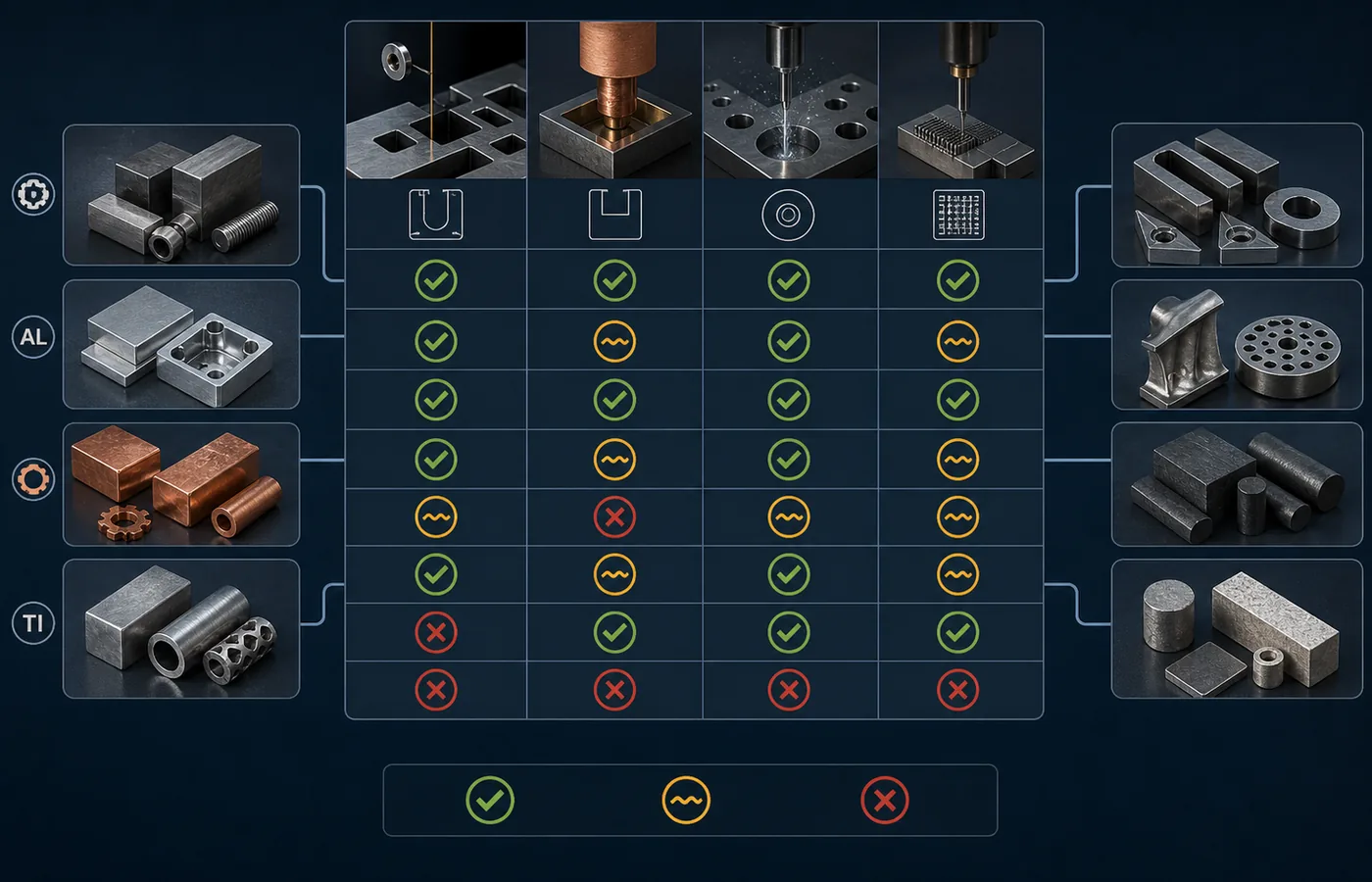
EDM material compatibility starts with conductivity but is decided by thermal response, microstructure, supplied condition, residual stress, edge behavior, and surface acceptance. This page is the material-family screening overview.
Quick Answer
A detailed EDM material review uses the exact grade, supplied condition, residual-stress state, functional surfaces, and inspection requirements—not only the material family name.
Key Material Points
Material Behavior
Treating all stainless, tool steel, copper, titanium, or nickel alloys as one material family hides condition-specific distortion and surface risks. The consequence changes fit, function, or service performance for the Material Compatibility decision; it is not only a change in surface appearance.
Process Fit
Identify the material family and exact condition, then compare its thermal, stress, edge, and surface behavior with the feature access and functional-face requirement.
Risks to Manage
The main error is treating electrical conductivity as the only compatibility test. Exact grade, heat-treatment condition, residual stress, edge geometry, corrosion response, and surface-integrity acceptance can change the route even when the material is fully conductive.
How the Material Responds
Electrical conductivity is only the first material gate for EDM. After that, thermal conductivity, melting behavior, microstructure, hardness condition, residual stress, and corrosion response determine how stable the spark gap is and what the finished surface can accept. Soft aluminum may round at fragile edges, hardened tool steel can move as stress is released, carbide can lose binder and chip, and titanium can form a contaminated recast layer. Material compatibility therefore means matching the exact grade and condition to process access, finishing energy, and inspection—not simply confirming that the workpiece conducts electricity.
EDM Material Family Screening
| Material family | Primary EDM behavior | Main planning question |
|---|---|---|
| Aluminum and copper alloys | High conductivity and soft edges | Can flushing and energy stay stable without rounding the feature? |
| Hardened steels | Hardness-independent cutting with residual stress | Will the part move as the profile or cavity opens? |
| Titanium and nickel alloys | Heat remains near the surface | What recast, contamination, or fatigue limit applies? |
| Carbide and conductive ceramics | Binder and hard phase erode differently | Can edge chipping and subsurface damage be accepted? |
Condition and Process Behavior
Electrical conductivity is the entry requirement for EDM, but it does not predict the whole result. Thermal conductivity, melting behavior, microstructure, heat treatment, binder phases, and the functional surface determine removal stability, recast, distortion, and inspection. Screen the exact grade and condition first, then choose the EDM process from feature access and release only the surfaces that need special control.
Surface Integrity
For this material family, surface acceptance follows the exact grade and condition. Separate roughness from corrosion, passivation, fatigue, contact, or post-process requirements on the functional faces. For Material Compatibility, tie the accepted condition to the feature and inspection method named in the drawing.
Material Compatibility Screening Checkpoints
- Confirm the workpiece is conductive through the feature path, not only at the surface.
- Identify the material family, exact grade, and condition that control thermal, stress, and surface response.
- Choose the EDM route and surface acceptance from the feature rather than from conductivity alone.
Limits and Better Alternatives
Main Limit
Electrical conductivity only confirms that EDM is possible; it does not approve the grade, condition, geometry, or functional surface. The route remains open until distortion, recast, edge strength, corrosion or fatigue exposure, and inspection capability are defined.
Practical Next Step
For this material family, surface acceptance follows the exact grade and condition. Use the overview to confirm that EDM is possible, then use this detailed guide to compare grade-specific support, finishing, corrosion, wear, and surface-integrity controls.
What to Remember
Conductivity opens the door to EDM; grade, condition, geometry, and surface function decide whether the material-process combination is practical.
Technical Reference
Use the values as planning references and define the functional requirement on the controlled drawing.
Use This Guide to Prepare Your RFQ
Contact us when your drawing and requirements are ready for review.
- Drawing or part sketch
- Material grade
- Thickness / part size
- Quantity
STEP/STP, DXF, DWG, PDF, IGS/IGES or ZIP.
Confidential drawing review. NDA support available on request.
Frequently Asked Questions
Is electrical conductivity enough to approve a material for EDM?
No. It is the first gate. Thermal response, microstructure, residual stress, brittle edges, corrosion, and recast acceptance still determine whether the route is practical.
Can coated or composite materials be EDM machined?
Only when a continuous conductive path exists and the interface behavior is understood. Coatings and conductive binders can change after the discharge penetrates them.
Why does supplied condition matter?
Annealed, hardened, aged, cold-worked, and stress-relieved states can move differently and accept different finishing energy.
What is the first drawing check?
State the exact grade and condition, then mark the feature access and functional faces.