
Technical Reference
Edm Corner Radius Guide
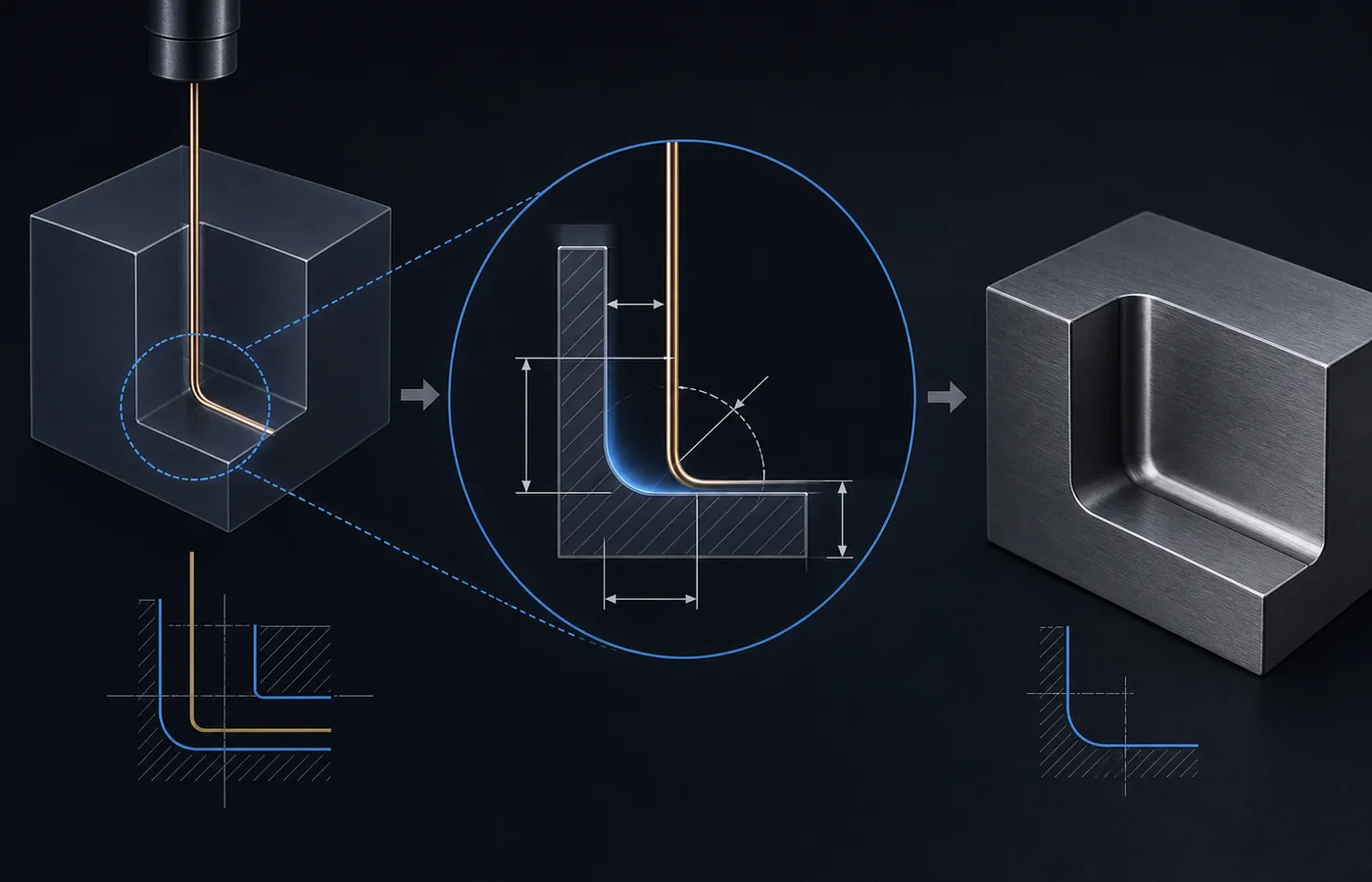
The smallest practical internal corner follows electrode or wire geometry plus the discharge gap; the exact route depends on through or blind access. A zero-radius internal corner cannot be produced by ordinary EDM geometry.
Quick Answer
The smallest practical internal corner follows electrode or wire geometry plus the discharge gap; the exact route depends on through or blind access.
Key Technical Points
What the Parameter Changes
Calling out a sharp internal corner without identifying access can force the wrong process or an impossible radius. The consequence changes fit, function, or service performance for the Internal Corner Radius decision; it is not only a change in surface appearance.
How to Select It
Use Wire EDM radii for through profiles and shaped Sinker or Micro EDM electrodes for blind details. When planning Internal Corner Radius, apply the requirement only to the dimensions and faces that control fit, function, service life, or documented release.
What Can Go Wrong
A zero-radius internal corner cannot be produced by ordinary EDM geometry. The minimum corner follows wire or electrode size, spark gap, wear, orbit, and finishing allowance; ignoring those limits creates an unmachinable drawing or an oversized corner.
Technical Context
A wire or shaped electrode cannot create an infinitely sharp internal corner. In Wire EDM the practical radius is governed by wire radius plus the working gap and path dynamics; in sinker or micro EDM it also depends on electrode corner wear and orbit. This mechanism explains the limits and behavior that matter when planning Internal Corner Radius.
Feature-Size Decision Table
| Condition or input | Why it matters | What must be confirmed |
|---|---|---|
| Electrode or wire size | sets stiffness and contributes to kerf or corner radius | available size, wear, current capacity, breakage risk |
| Spark gap | adds to slot width or cavity offset | material, energy, pass, and machine technology |
| Depth or section height | changes flushing and deflection | aspect ratio, guide spacing, support, and inspection |
| Inspection method | sets the smallest feature that can be released | probe size, optics, magnification, datum, and uncertainty |
Surface Considerations
Assign surface, edge, and sub-surface requirements only where they affect function, and give each requirement its own acceptance method. For Internal Corner Radius, tie the accepted condition to the feature and inspection method named in the drawing.
Internal Corner Radius Drawing and Release Checkpoints
- Identify the controlled feature, material condition, access direction, and functional datum for this Internal Corner Radius decision.
- Separate dimensional requirements from texture, edge, recast, corrosion, fatigue, or post-process acceptance.
- State the inspection method, sampling or first-article requirement, drawing revision, quantity, and any documentation needed for release.
Limits and Better Alternatives
Main Limit
For EDM Internal Corner Radius Guide, a round wire and discharge gap cannot create a true zero-radius internal corner. Corner control improves the result but does not remove the physical radius. When that boundary dominates, use a larger feature, shorter aspect ratio, Sinker or Micro EDM for a different access condition, or redesign the internal corner when the physical limit is not functional.
Consider Another Route When
Use a larger feature, shorter aspect ratio, Sinker or Micro EDM for a different access condition, or redesign the internal corner when the physical limit is not functional.
Practical Next Step
Assign surface, edge, and sub-surface requirements only where they affect function, and give each requirement its own acceptance method. Use Wire EDM radii for through profiles and shaped Sinker or Micro EDM electrodes for blind details.
What to Remember
The smallest practical internal corner follows electrode or wire geometry plus the discharge gap; the exact route depends on through or blind access. Apply the parameter only to named features with a datum, process stage, and measurement method.
Technical Reference
Use the values as planning references and define the functional requirement on the controlled drawing.
Use This Guide to Prepare Your RFQ
Contact us when your drawing and requirements are ready for review.
- Drawing or part sketch
- Material grade
- Thickness / part size
- Quantity
STEP/STP, DXF, DWG, PDF, IGS/IGES or ZIP.
Confidential drawing review. NDA support available on request.
Frequently Asked Questions
Can Wire EDM make a zero-radius internal corner?
No. Wire radius and spark gap leave a finite internal radius.
Does smaller wire always improve the result?
No. It can reduce stiffness, speed, and stability.
What should be dimensioned?
Specify the finished feature, depth or height, radius, tolerance, and inspection method.
When should another EDM route be used?
Use Sinker or Micro EDM when access or feature scale differs from a normal through profile.