
Technical Reference
What Is Small Hole EDM Drilling
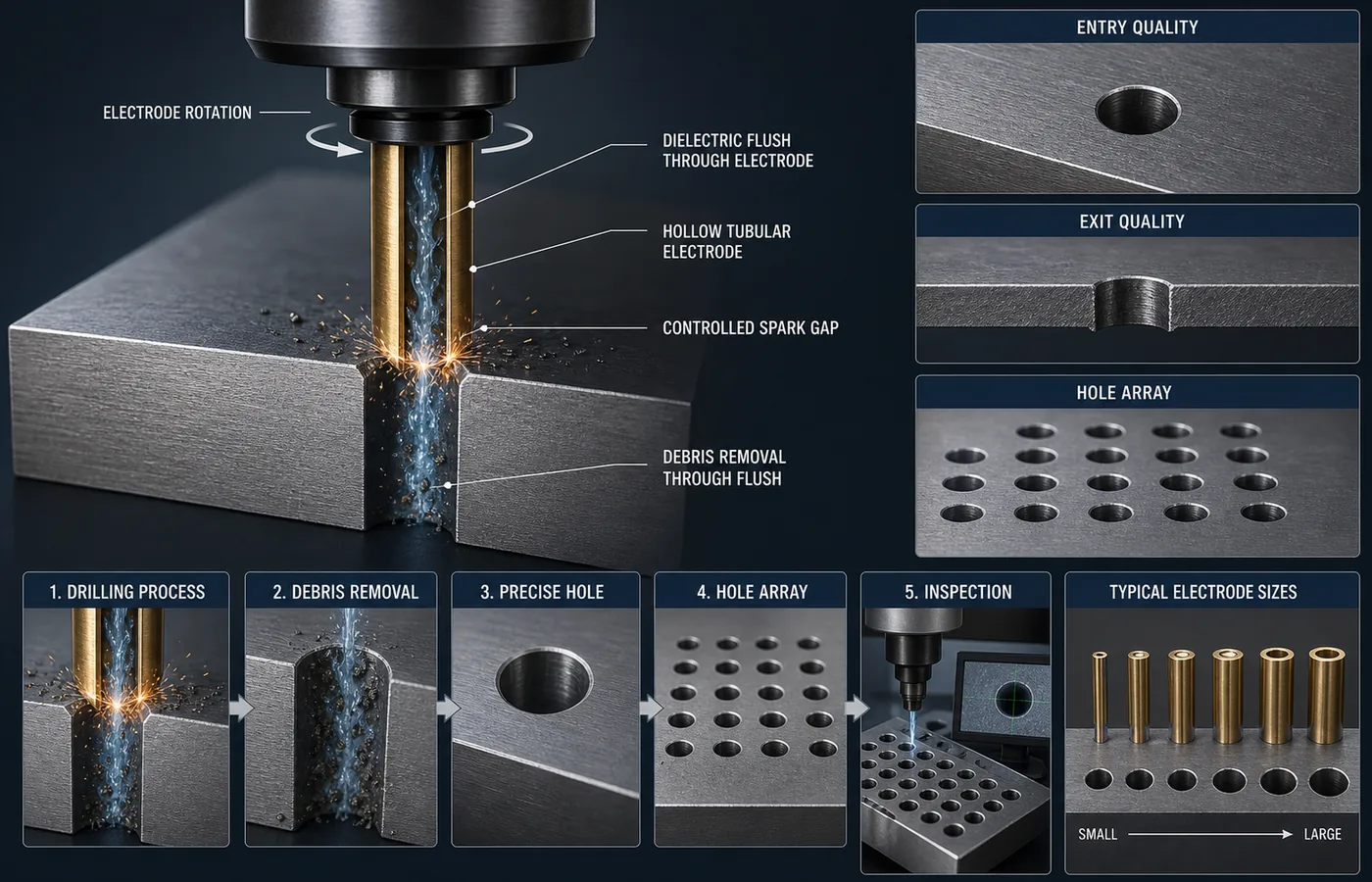
Small Hole EDM drills conductive material with a rotating tubular electrode and internal high-pressure flushing. Small Hole EDM does not automatically guarantee straightness at extreme depth-to-diameter ratios.
Quick Answer
Small Hole EDM drills conductive material with a rotating tubular electrode and internal high-pressure flushing.
Concept Summary
What It Is
Small Hole EDM uses a rotating tubular electrode with pressurized dielectric pumped through its center to drill small, deep holes in conductive material. Rotation helps maintain straightness, and internal flushing clears debris from the advancing hole.
What It Can Do
Select it from the actual diameter, path depth, angle, aspect ratio, positional tolerance, and breakthrough condition. When planning Small Hole EDM Drilling, apply the requirement only to the dimensions and faces that control fit, function, service life, or documented release.
What It Cannot Do
Small Hole EDM does not automatically guarantee straightness at extreme depth-to-diameter ratios. Electrode runout, flushing, material variation, and breakthrough support can shift the exit position or wall condition even when the entry diameter is correct.
How It Works
A rotating tubular electrode feeds toward the workpiece while dielectric is pumped through its center. Repeated discharges open the hole and the internal flow removes debris; electrode runout, path depth, rotation, flushing, and breakthrough support control straightness and wall condition. This mechanism explains the limits and behavior that matter when planning Small Hole EDM Drilling.
Small Hole EDM Conditional Planning
| Condition or input | What changes | What must be confirmed |
|---|---|---|
| small, deep, angled, vent, cooling, or start hole | Defines whether the process access is valid | electrode diameter, true path depth, aspect ratio, flushing, rotation, straightness, and breakthrough support |
| Material condition | Changes support, wear, stability, and surface response | Exact grade, condition, and functional faces |
| Depth or section height | Changes flushing, wear, deflection, or metrology | True feature depth, aspect ratio, datum, and inspection |
| Finish stage | Changes texture and final size together | Rough/finish sequence and allowance |
Surface and Edge Effects
Inspect entrance, bore wall, straightness, and breakthrough edge separately. Hole-wall texture is feature-dependent and cannot be reduced to one whole-part Ra callout. For Small Hole EDM Drilling, tie the accepted condition to the feature and inspection method named in the drawing.
Small Hole EDM Drilling Drawing and Release Checkpoints
- Identify the controlled feature, material condition, access direction, and functional datum for this Small Hole EDM Drilling decision.
- Separate dimensional requirements from texture, edge, recast, corrosion, fatigue, or post-process acceptance.
- State the inspection method, sampling or first-article requirement, drawing revision, quantity, and any documentation needed for release.
Limits and Better Alternatives
Main Limit
For What Is Small Hole EDM Drilling? the guide applies to the named technical decision and does not replace the drawing-specific review of geometry, material, setup, and inspection. When that boundary dominates, use mechanical drilling for accessible easy-cutting material, laser drilling for suitable thin high-volume parts, or Micro EDM for smaller precision holes.
Consider Another Route When
Use mechanical drilling for accessible easy-cutting material, laser drilling for suitable thin high-volume parts, or Micro EDM for smaller precision holes.
Practical Next Step
Inspect entrance, bore wall, straightness, and breakthrough edge separately. Select it from the actual diameter, path depth, angle, aspect ratio, positional tolerance, and breakthrough condition.
What to Remember
Small Hole EDM drills conductive material with a rotating tubular electrode and internal high-pressure flushing. Use the process only where its physical access and feature limits fit the drawing, then release the result against a named inspection method.
Technical Reference
Use the values as planning references and define the functional requirement on the controlled drawing.
Use This Guide to Prepare Your RFQ
Contact us when your drawing and requirements are ready for review.
- Drawing or part sketch
- Material grade
- Thickness / part size
- Quantity
STEP/STP, DXF, DWG, PDF, IGS/IGES or ZIP.
Confidential drawing review. NDA support available on request.
Frequently Asked Questions
Why use a tubular electrode?
The bore carries dielectric through the growing hole so debris can leave the discharge gap.
Does plate thickness equal hole depth?
Not for angled or blind holes; specify the true electrode path.
What should be inspected?
Check entrance, bore wall, straightness, position, and exit condition separately.
When is Micro EDM needed?
Use Micro EDM when the feature scale or tolerance is below ordinary small-hole capability.