
Technical Reference
What Is Wire EDM
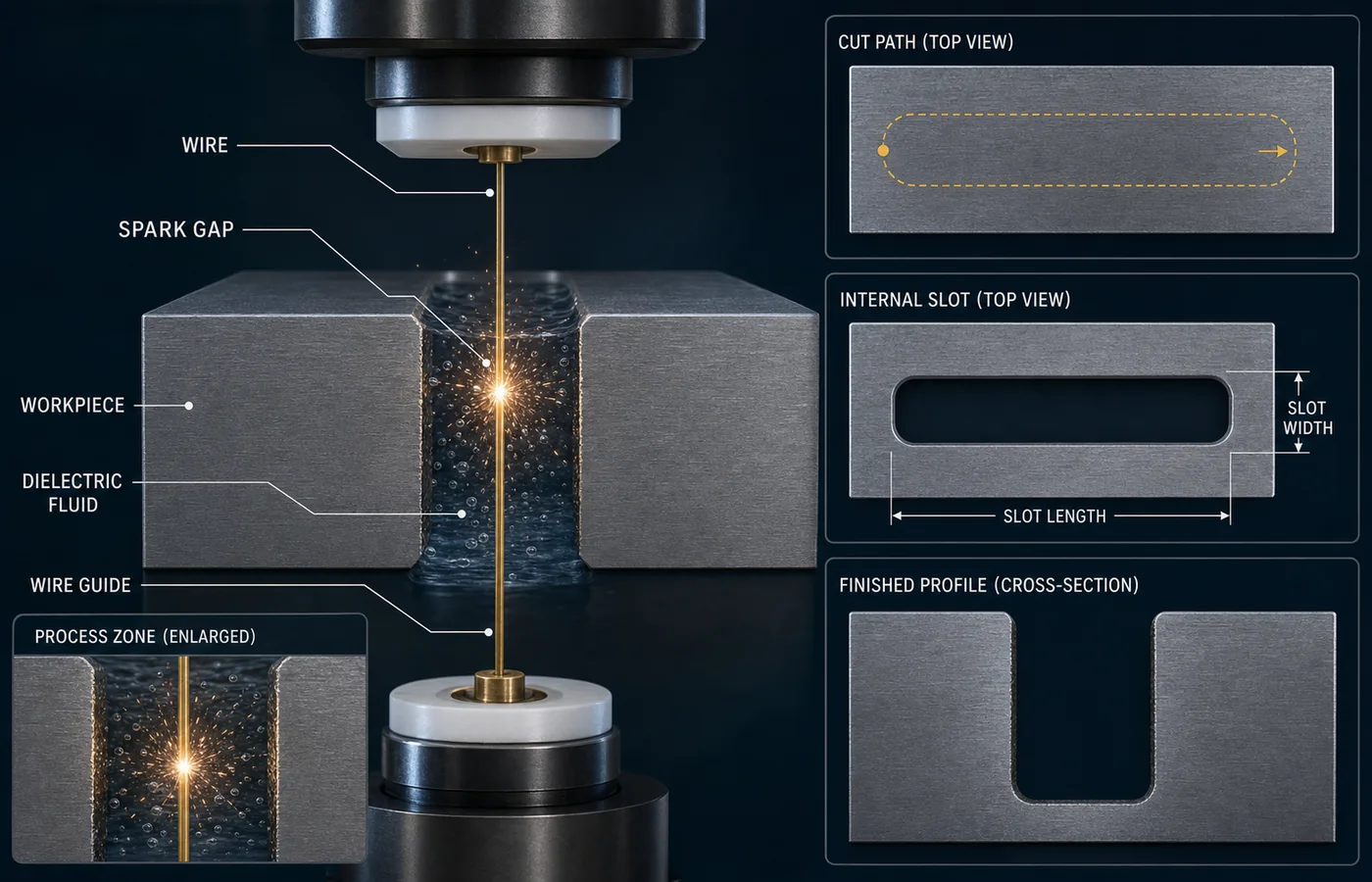
Wire EDM cuts a programmed through profile with a continuously moving wire electrode, pulsed discharges, and deionized water; the wire never contacts the workpiece. Wire EDM cannot cut a closed blind cavity because the wire must pass completely through the workpiece from an edge or a start hole.
Quick Answer
Wire EDM cuts a programmed through profile with a continuously moving wire electrode, pulsed discharges, and deionized water; the wire never contacts the workpiece.
Concept Summary
What It Is
Wire EDM cuts a programmed through profile with a continuously moving wire electrode in deionized water. The wire never touches the workpiece, and it must pass completely through the material from an edge or a start hole.
What It Can Do
Use it for conductive through profiles, narrow slots, punches, inserts, and tapered walls when the wire can enter from an edge or start hole. When planning Wire EDM, apply the requirement only to the dimensions and faces that control fit, function, service life, or documented release.
What It Cannot Do
Wire EDM cannot cut a closed blind cavity because the wire must pass completely through the workpiece from an edge or a start hole. Internal corner radius is also limited by the wire radius plus the spark gap; a true zero-radius corner needs Sinker EDM or a secondary operation.
How It Works
A continuously moving wire is held in a controlled spark gap while pulsed discharges remove a through profile. Deionized water cools the cut and carries debris away; wire tension, guide alignment, flushing, and successive trim passes control kerf, verticality, and finish. This mechanism explains the limits and behavior that matter when planning Wire EDM.
Wire EDM Conditional Planning
| Condition or input | What changes | What must be confirmed |
|---|---|---|
| through profile or slot | Defines whether the process access is valid | wire diameter, kerf compensation, flushing, wire tension, guide alignment, taper, and trim-pass stability |
| Material condition | Changes support, wear, stability, and surface response | Exact grade, condition, and functional faces |
| Depth or section height | Changes flushing, wear, deflection, or metrology | True feature depth, aspect ratio, datum, and inspection |
| Finish stage | Changes texture and final size together | Rough/finish sequence and allowance |
Surface and Edge Effects
Inspect entry and exit edges, verticality, wire-break marks, and the functional cut faces. Skim passes can improve texture and size together, so the final offset and datum must match the inspection plan. For Wire EDM, tie the accepted condition to the feature and inspection method named in the drawing.
Wire EDM Drawing and Release Checkpoints
- Identify the controlled feature, material condition, access direction, and functional datum for this Wire EDM decision.
- Separate dimensional requirements from texture, edge, recast, corrosion, fatigue, or post-process acceptance.
- State the inspection method, sampling or first-article requirement, drawing revision, quantity, and any documentation needed for release.
Limits and Better Alternatives
Main Limit
For What Is Wire EDM? the guide applies to the named technical decision and does not replace the drawing-specific review of geometry, material, setup, and inspection. When that boundary dominates, use Sinker EDM for blind forms, CNC for accessible open geometry, or laser cutting when thin-sheet speed matters more than EDM precision.
Consider Another Route When
Use Sinker EDM for blind forms, CNC for accessible open geometry, or laser cutting when thin-sheet speed matters more than EDM precision.
Practical Next Step
Inspect entry and exit edges, verticality, wire-break marks, and the functional cut faces. Use it for conductive through profiles, narrow slots, punches, inserts, and tapered walls when the wire can enter from an edge or start hole.
What to Remember
Wire EDM cuts a programmed through profile with a continuously moving wire electrode, pulsed discharges, and deionized water; the wire never contacts the workpiece. Use the process only where its physical access and feature limits fit the drawing, then release the result against a named inspection method.
Technical Reference
Use the values as planning references and define the functional requirement on the controlled drawing.
Use This Guide to Prepare Your RFQ
Contact us when your drawing and requirements are ready for review.
- Drawing or part sketch
- Material grade
- Thickness / part size
- Quantity
STEP/STP, DXF, DWG, PDF, IGS/IGES or ZIP.
Confidential drawing review. NDA support available on request.
Frequently Asked Questions
How does Wire EDM remove material?
Pulsed discharges melt microscopic volumes across a controlled gap while the wire moves continuously through deionized water.
Can Wire EDM make blind cavities?
No. A continuous through path is required; blind forms normally use Sinker EDM.
Does material hardness matter?
Hardness does not create cutting force, but material condition still affects speed, stress release, and surface planning.
What controls the inside radius?
Wire radius, spark gap, corner strategy, material, and section height set the practical internal radius.