
Technical Reference
Sinker EDM Tolerance Guide Technical Reference
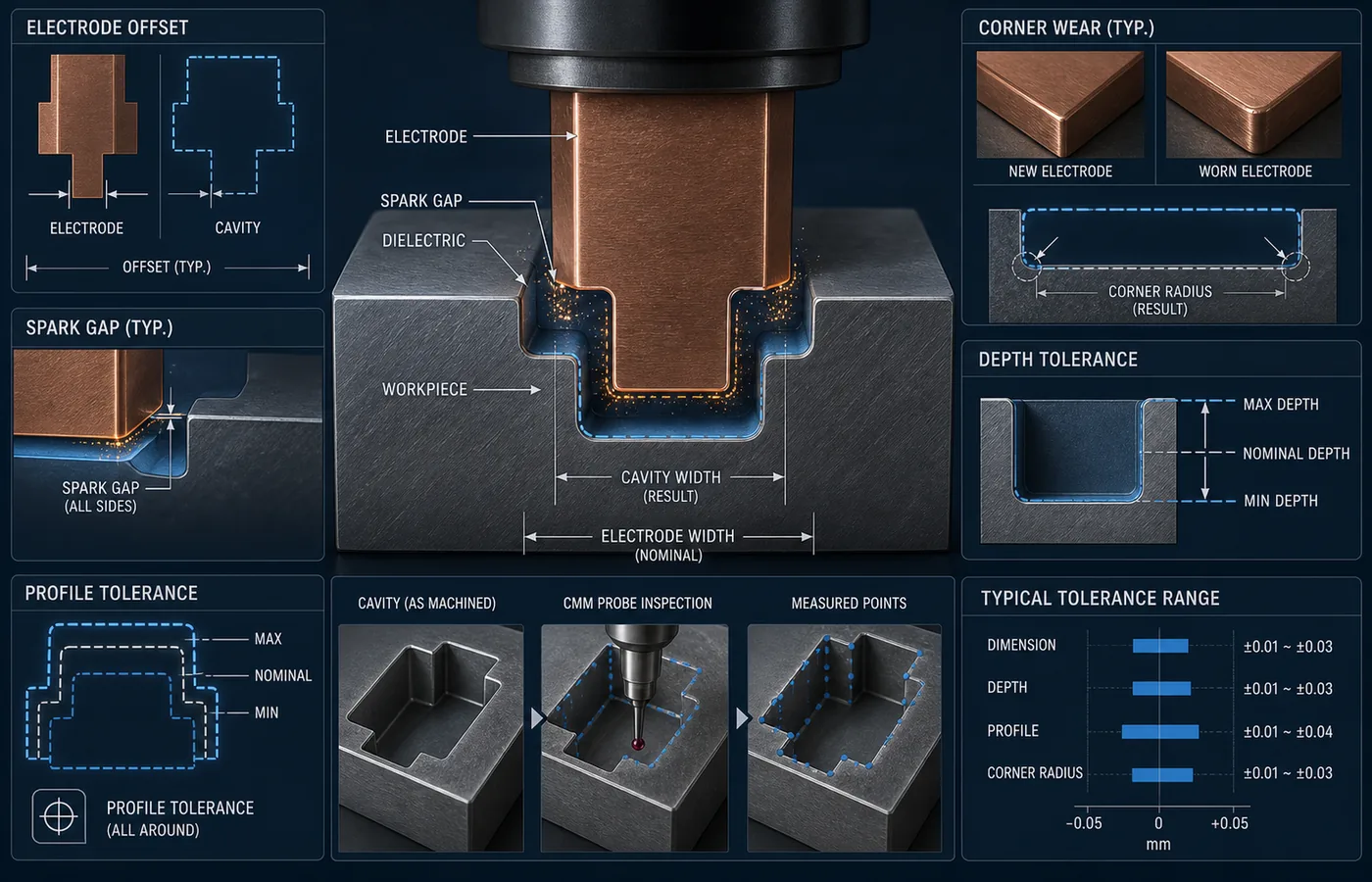
For Sinker EDM, assign tolerance to the cavity walls, ribs, floors, and depths that control function. Sinker EDM tolerance is lost through electrode wear, orbit error, thermal drift, debris trapping, and inconsistent datum transfer.
Quick Answer
For Sinker EDM, assign tolerance to the cavity walls, ribs, floors, and depths that control function. Plan electrode wear, orbit strategy, discharge gap, flushing, datum control, and inspection together.
Key Technical Points
What the Parameter Changes
Deep narrow cavities, corner growth, and electrode wear can consume tolerance even when the surface finish looks acceptable. The consequence changes fit, function, or service performance for the Sinker EDM Tolerance decision; it is not only a change in surface appearance.
How to Select It
Assign the band to cavity depth, ribs, walls, and fits that control function; inspect from the same datum used to locate the electrode. When planning Sinker EDM Tolerance, apply the requirement only to the dimensions and faces that control fit, function, service life, or documented release.
What Can Go Wrong
Sinker EDM tolerance is lost through electrode wear, orbit error, thermal drift, debris trapping, and inconsistent datum transfer. Applying one tight value to every cavity wall and floor adds cost without controlling the functional geometry.
Technical Context
EDM tolerance is the combined result of machine positioning, electrode or wire geometry, spark-gap compensation, material stability, section height or cavity depth, finishing passes, datum control, and measurement. A quoted range is meaningful only when those conditions are named. This mechanism explains the limits and behavior that matter when planning Sinker EDM Tolerance.
Conditional Tolerance Planning
| Process | Condition that must be named | Planning reference | What degrades the result |
|---|---|---|---|
| Sinker EDM | Accessible cavity with controlled electrode wear | ±0.008–0.030 mm planning band | cavity depth, orbit, corner wear, debris evacuation |
Precision Release Levels
| Level | Use when | Release requirement |
|---|---|---|
| Standard | fit is tolerant of normal process variation | confirm material, feature depth or section height, datum, and standard inspection |
| Precision | selected dimensions control fit or alignment | add finishing-pass strategy, stable temperature, and matching machining/inspection datum |
| Special capability review | requirement is tighter than the normal planning band | run a feature-specific feasibility review, test cut, or first article before batch release |
Surface Considerations
Inspect cavity floors, ribs, corners, and debris-trap zones separately. Electrode wear and orbit can produce different texture and size at the floor, wall, and corner of the same cavity. For Sinker EDM Tolerance, tie the accepted condition to the feature and inspection method named in the drawing.
Sinker EDM Tolerance Drawing and Release Checkpoints
- Identify the controlled feature, material condition, access direction, and functional datum for this Sinker EDM Tolerance decision.
- Separate dimensional requirements from texture, edge, recast, corrosion, fatigue, or post-process acceptance.
- State the inspection method, sampling or first-article requirement, drawing revision, quantity, and any documentation needed for release.
Limits and Better Alternatives
Main Limit
A Sinker EDM tolerance range cannot approve every cavity wall, rib, corner, and floor equally; electrode access, depth, wear, and inspection capability set the practical boundary.
Consider Another Route When
Widen nonfunctional dimensions, split simple precision faces to grinding, or use a hybrid EDM/CNC route where one process does not need to hold every feature.
Practical Next Step
Inspect cavity floors, ribs, corners, and debris-trap zones separately. Assign the band to cavity depth, ribs, walls, and fits that control function; inspect from the same datum used to locate the electrode.
What to Remember
For Sinker EDM, assign tolerance to the cavity walls, ribs, floors, and depths that control function. A numeric target is ready for release when its feature, conditions, allowance, and inspection method are explicit.
Technical Reference
Use the values as planning references and define the functional requirement on the controlled drawing.
Use This Guide to Prepare Your RFQ
Contact us when your drawing and requirements are ready for review.
- Drawing or part sketch
- Material grade
- Thickness / part size
- Quantity
STEP/STP, DXF, DWG, PDF, IGS/IGES or ZIP.
Confidential drawing review. NDA support available on request.
Frequently Asked Questions
Should every dimension use the tightest EDM tolerance?
No. Assign the tight band only to dimensions that control fit or function.
Why must machining and inspection datums match?
A different datum can make a capable feature fail the reported result.
Do finishing passes affect size?
Yes. Trim, orbit, or finish passes alter the final dimension as well as the texture.
What should the drawing identify?
Mark controlled features, datums, material condition, tolerance, and inspection method.