
Technical Reference
Micro EDM Design Guide Technical Reference
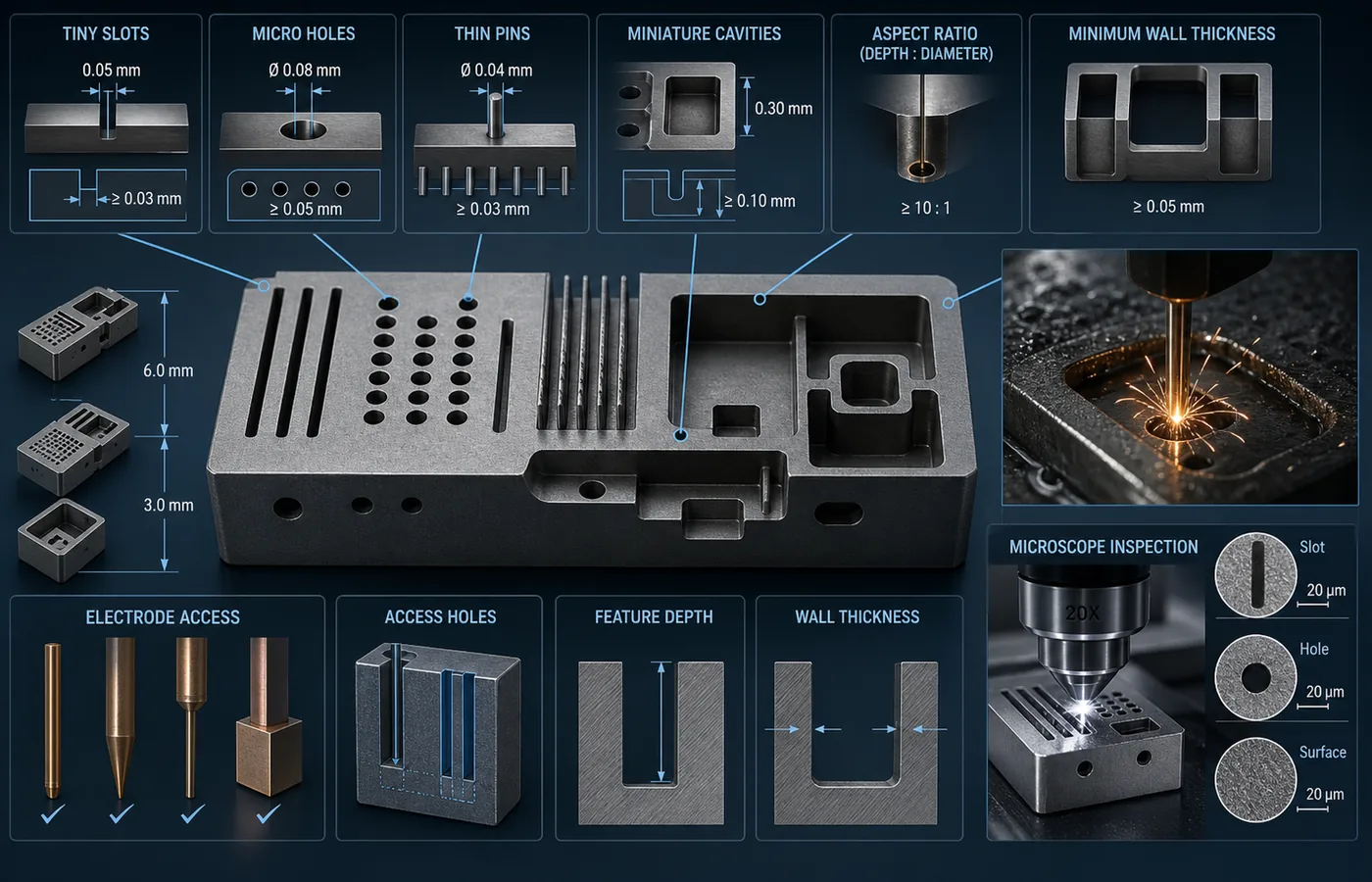
Micro EDM design begins with a measurable feature, a practical electrode, and enough access for stable dielectric flow. Micro EDM design fails when feature scale, electrode wear, aspect ratio, edge radius, flushing, and metrology are treated separately.
Quick Answer
Micro EDM design begins with a measurable feature, a practical electrode, and enough access for stable dielectric flow.
Key Technical Points
What the Parameter Changes
Extremely fine electrodes increase wear, breakage risk, cycle time, and uncertainty at the finished edge. The consequence changes fit, function, or service performance for the Micro EDM Design decision; it is not only a change in surface appearance.
How to Select It
Dimension the finished feature, edge radius, aspect ratio, datum, and inspection method; do not design only from a nominal electrode size. When planning Micro EDM Design, apply the requirement only to the dimensions and faces that control fit, function, service life, or documented release.
What Can Go Wrong
Micro EDM design fails when feature scale, electrode wear, aspect ratio, edge radius, flushing, and metrology are treated separately. The feature may be cut but cannot be released if wear or measurement uncertainty consumes the tolerance.
Technical Context
A fine electrode and low-energy pulses remove very small volumes without cutting force. At this scale, electrode wear, gap stability, dielectric access, thermal drift, and optical measurement resolution can be as important as the programmed tool path. This mechanism explains the limits and behavior that matter when planning Micro EDM Design.
Micro EDM Conditional Planning
| Condition or input | What changes | What must be confirmed |
|---|---|---|
| micro hole, micro slot, miniature cavity, or fine pin | Defines whether the process access is valid | electrode wear, feature-to-electrode ratio, micro-flushing, aspect ratio, edge radius, thermal stability, and measurement resolution |
| Material condition | Changes support, wear, stability, and surface response | Exact grade, condition, and functional faces |
| Depth or section height | Changes flushing, wear, deflection, or metrology | True feature depth, aspect ratio, datum, and inspection |
| Finish stage | Changes texture and final size together | Rough/finish sequence and allowance |
Surface Considerations
At micro scale, electrode wear can round entry edges or make repeated features drift even when the average surface texture is fine. Define edge radius, waviness, feature count, and optical inspection where those details control function. For Micro EDM Design, tie the accepted condition to the feature and inspection method named in the drawing.
Micro EDM Design Drawing and Release Checkpoints
- Identify the controlled feature, material condition, access direction, and functional datum for this Micro EDM Design decision.
- Separate dimensional requirements from texture, edge, recast, corrosion, fatigue, or post-process acceptance.
- State the inspection method, sampling or first-article requirement, drawing revision, quantity, and any documentation needed for release.
Limits and Better Alternatives
Main Limit
For Micro EDM Design Guide, the guide applies to the named technical decision and does not replace the drawing-specific review of geometry, material, setup, and inspection. When that boundary dominates, increase the feature size, shorten the aspect ratio, use precision laser processing for suitable thin geometry, or split the feature into a hybrid process.
Consider Another Route When
Increase the feature size, shorten the aspect ratio, use precision laser processing for suitable thin geometry, or split the feature into a hybrid process.
Practical Next Step
At micro scale, electrode wear can round entry edges or make repeated features drift even when the average surface texture is fine. Dimension the finished feature, edge radius, aspect ratio, datum, and inspection method; do not design only from a nominal electrode size.
What to Remember
Micro EDM design begins with a measurable feature, a practical electrode, and enough access for stable dielectric flow. Apply the parameter only to named features with a datum, process stage, and measurement method.
Need Help Reviewing an EDM Drawing?
Send a question or drawing for a compact technical review.
- Drawing or part sketch
- Material grade
- Thickness / part size
- Quantity
STEP/STP, DXF, DWG, PDF, IGS/IGES or ZIP.
Confidential drawing review. NDA support available on request.
Frequently Asked Questions
Should I specify the electrode diameter?
Specify the finished feature and radius; the process planner selects the electrode and allowance.
What limits deep micro features?
Electrode stiffness, wear, flushing, and metrology become less stable as aspect ratio rises.
Can Micro EDM make zero-radius corners?
No. The electrode and discharge gap leave a finite radius.
What files are useful?
Send the model, dimensioned drawing, material condition, feature depth, tolerance, edge requirement, and inspection method.