
Technical Reference
EDM Material Compatibility Guide
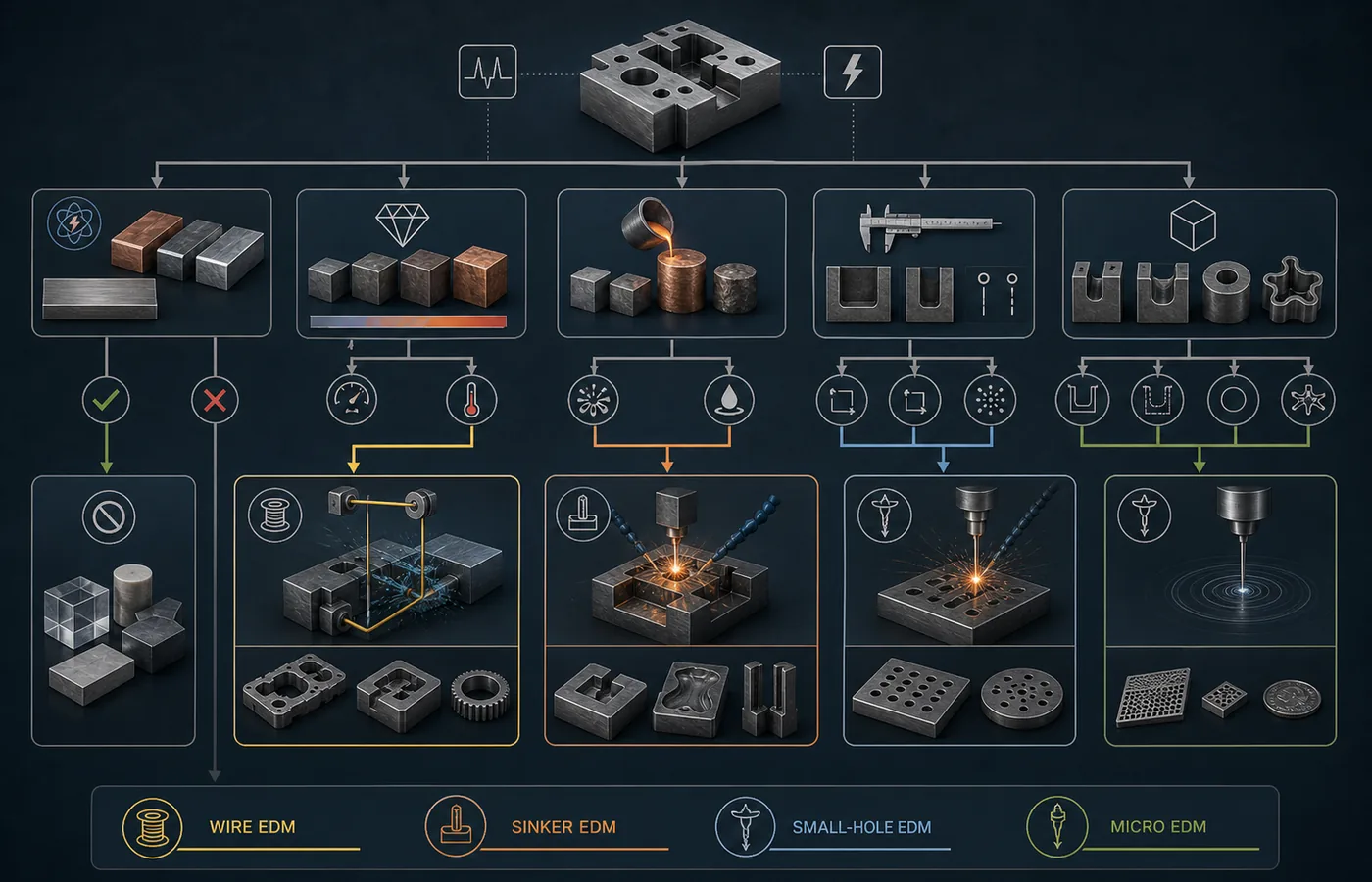
This technical reference turns material compatibility into a release checklist: formal grade, condition, conductive path, coating or composite interfaces, functional surfaces, post-process, and evidence.
Quick Answer
EDM material selection starts with electrical conductivity, supplied condition, feature geometry and surface-integrity needs.
Key Material Points
Material Behavior
EDM handles hardness well, but very conductive, brittle or reactive materials need different energy, support and inspection. The consequence changes fit, function, or service performance for the Material Compatibility decision; it is not only a change in surface appearance.
Process Fit
Release the formal alloy and specification, supplied condition, layer or interface structure, functional faces, and required certificate before selecting the EDM settings and inspection route.
Risks to Manage
A material can be EDM-compatible and still be unsuitable for the released function. Family names such as stainless steel, tool steel, or aluminum hide grade-specific stress, corrosion, recast, and post-process requirements that must be tied to the actual drawing.
How the Material Responds
A release-ready EDM material decision needs the exact grade, supplied condition, conductive path, coatings or inserts, and the functional surface requirement. Conductive composites may spark only through a binder network; case-hardened or plated parts may change behavior after the surface layer is penetrated; solution-treated and aged alloys can move differently as stress is released. Record those conditions on the drawing and inspection plan before selecting wire, electrode, energy, flushing, or post-process requirements.
Material Release Data
| Release item | Required entry | Common failure if omitted |
|---|---|---|
| Identity | Formal alloy and specification | Wrong settings or wrong commercial classification |
| Condition | Temper, age, hardness, stress relief, or cold work | Unexpected movement or recast response |
| Layer/interface | Coating, plating, case depth, or composite structure | Unstable gap after the layer is penetrated |
| Functional surface | Fatigue, seal, corrosion, contact, or coating face | Surface is accepted by Ra while function remains at risk |
| Evidence | Certificate and inspection method | Material and result cannot be tied to the released revision |
Condition and Process Behavior
A material-compatibility review should decide more than whether sparks can occur. It should identify the exact grade and state, expected distortion, edge or binder damage, corrosion or fatigue sensitivity, and the inspection method that can prove the final surface. Use this route as the release checklist after basic conductivity screening, not as a substitute for grade-specific data.
Surface Integrity
For this material family, surface acceptance follows the exact grade and condition. Separate roughness from corrosion, passivation, fatigue, contact, or post-process requirements on the functional faces. For Material Compatibility, tie the accepted condition to the feature and inspection method named in the drawing.
Material Release and Drawing Checkpoints
- Write the formal grade, specification, supplied condition, and any coating or composite structure.
- Confirm a continuous conductive path through the feature and identify interfaces that change after penetration.
- Tie finishing, post-process, inspection, and certification to the same material callout and drawing revision.
Limits and Better Alternatives
Main Limit
A release-level compatibility decision requires the exact grade and state, not only a conductive material family. The part remains unapproved until feature access, distortion, surface failure mode, post-processing, and a capable inspection method are tied to the controlled drawing.
Practical Next Step
For this material family, surface acceptance follows the exact grade and condition. State the exact grade and heat-treatment condition.
What to Remember
A material is release-ready only when its identity, state, conductive path, interfaces, functional faces, and evidence are all tied to the drawing revision.
Need Help Reviewing an EDM Drawing?
Send a question or drawing for a compact technical review.
- Drawing or part sketch
- Material grade
- Thickness / part size
- Quantity
STEP/STP, DXF, DWG, PDF, IGS/IGES or ZIP.
Confidential drawing review. NDA support available on request.
Frequently Asked Questions
What material information must be released before production?
Formal grade, specification, condition, coating or plating, conductive path, functional faces, and required certification.
How are case-hardened or plated parts handled?
The surface layer and base metal can require different energy and acceptance. State layer thickness and whether the feature crosses the interface.
What makes a conductive composite risky?
The current may travel through a binder network rather than the hard phase, so erosion and edge quality can be nonuniform.
Can a supplier infer material condition from hardness?
No. Hardness alone does not identify the heat-treatment route, residual stress, or corrosion condition. State the actual condition.