
Technical Reference
Edm For Medical Device Parts
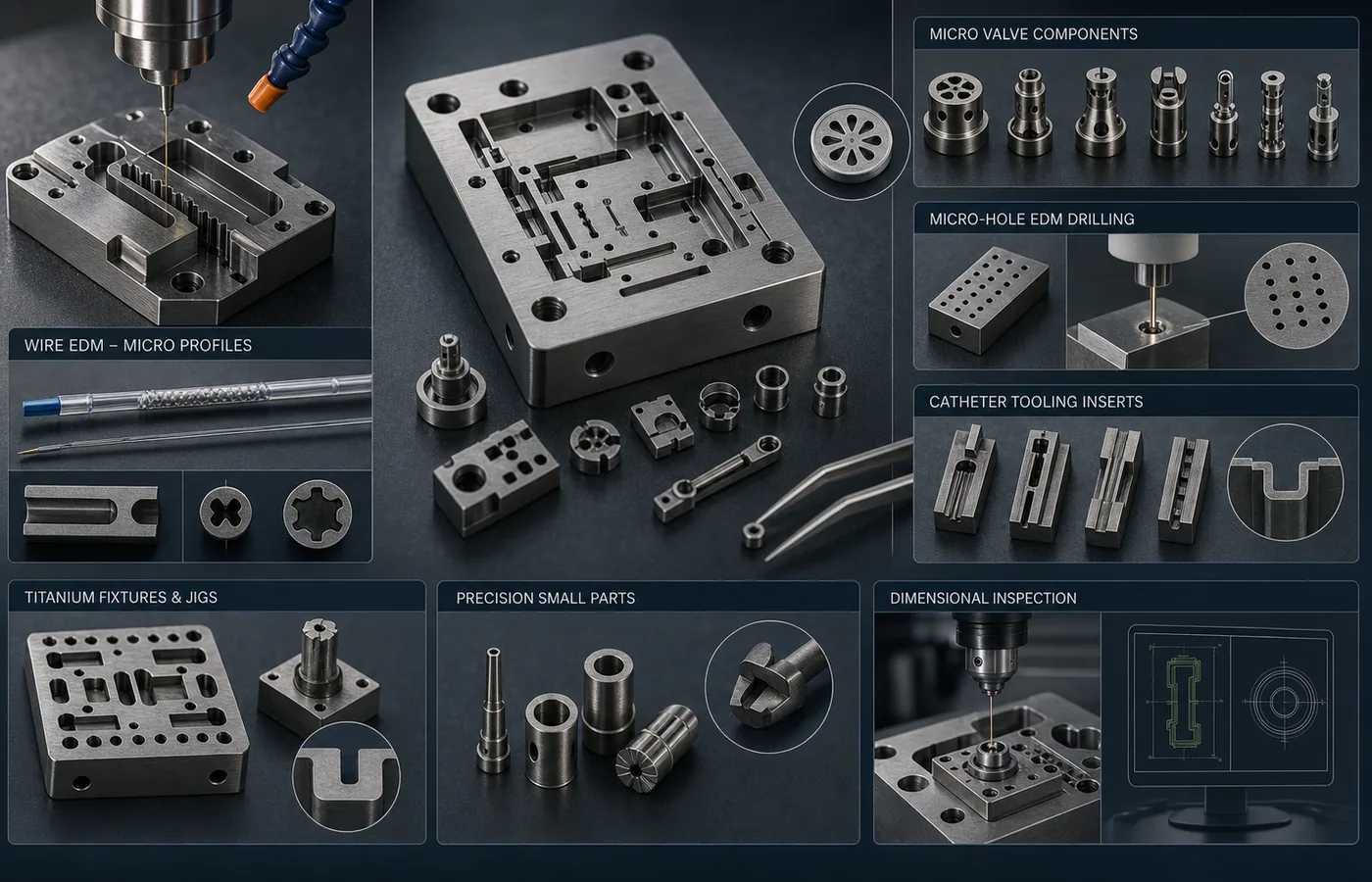
Medical-device EDM planning requires clean small features, controlled edges, traceable material condition, surface integrity, and an inspection method matched to function. Medical device parts fail when patient-contact, fatigue, cleanable, or miniature features are treated as ordinary geometry.
Quick Answer
Medical-device EDM planning requires clean small features, controlled edges, traceable material condition, surface integrity, and an inspection method matched to function.
Application Planning Points
What's at Stake
A dimensionally correct feature can still fail through particles, edge damage, recast, corrosion, or inadequate traceability. The consequence changes fit, function, or service performance for the Medical Device Components decision; it is not only a change in surface appearance.
How to Plan the Route
Identify cutting, contact, implant-adjacent, fluid, or assembly surfaces before choosing process and post-processing. When planning Medical Device Components, apply the requirement only to the dimensions and faces that control fit, function, service life, or documented release.
What Can Go Wrong
Medical device parts fail when patient-contact, fatigue, cleanable, or miniature features are treated as ordinary geometry. Surface integrity, edge condition, material traceability, and validated inspection must be released before production.
How EDM Fits
Medical-device EDM is useful where hard corrosion-resistant alloys, miniature features, burr-free edges, and narrow access make conventional tools risky. The non-contact cut avoids mechanical burrs and tool breakage, but it does not automatically create a biocompatible surface. Functional faces still need defined recast removal, cleaning, passivation, and inspection tied to the exact material and device function.
EDM for Medical Device Components Reference
| What you're asking | What you can expect |
|---|---|
| Planning axis | What to define |
| Part function | working feature and failure consequence |
| Process access | through, blind, hole, or micro |
| Material | grade and condition |
| Surface | functional face and post-process |
| Inspection | datum, method, report, and sample |
Material and Feature Context
Use conventional machining on open geometry and keep EDM on the hardened, inaccessible, burr-sensitive, or miniature features that justify it. Medical device parts fail when patient-contact, fatigue, cleanable, or miniature features are treated as ordinary geometry.
Functional Surface Requirements
Assign surface, edge, and sub-surface requirements only where they affect function, and give each requirement its own acceptance method. For Medical Device Components, tie the accepted condition to the feature and inspection method named in the drawing.
Medical Device Components Drawing and Release Checkpoints
- Identify the controlled feature, material condition, access direction, and functional datum for this Medical Device Components decision.
- Separate dimensional requirements from texture, edge, recast, corrosion, fatigue, or post-process acceptance.
- State the inspection method, sampling or first-article requirement, drawing revision, quantity, and any documentation needed for release.
Limits and Better Alternatives
Main Limit
For EDM for Medical Device Components, the guide applies to the named technical decision and does not replace the drawing-specific review of geometry, material, setup, and inspection. When that boundary dominates, use conventional machining on open geometry and keep EDM on the hardened, inaccessible, burr-sensitive, or miniature features that justify it.
Practical Next Step
Assign surface, edge, and sub-surface requirements only where they affect function, and give each requirement its own acceptance method. Identify cutting, contact, implant-adjacent, fluid, or assembly surfaces before choosing process and post-processing.
What to Remember
Medical-device EDM planning requires clean small features, controlled edges, traceable material condition, surface integrity, and an inspection method matched to function. Tie the EDM route to the actual part feature, service failure mode, material state, and inspection evidence.
Technical Reference
Use the values as planning references and define the functional requirement on the controlled drawing.
Use This Guide to Prepare Your RFQ
Contact us when your drawing and requirements are ready for review.
- Drawing or part sketch
- Material grade
- Thickness / part size
- Quantity
STEP/STP, DXF, DWG, PDF, IGS/IGES or ZIP.
Confidential drawing review. NDA support available on request.
Frequently Asked Questions
What selects the EDM process?
Feature access and scale, not the industry label alone.
Why are functional surfaces important?
They determine edge, finish, recast, corrosion, and post-processing.
Can several processes be used?
Yes. Hybrid routing is common.
What should be sent?
Send the drawing, material condition, critical feature, surfaces, quantity, and inspection needs.