
Technical Reference
Edm For Energy Components
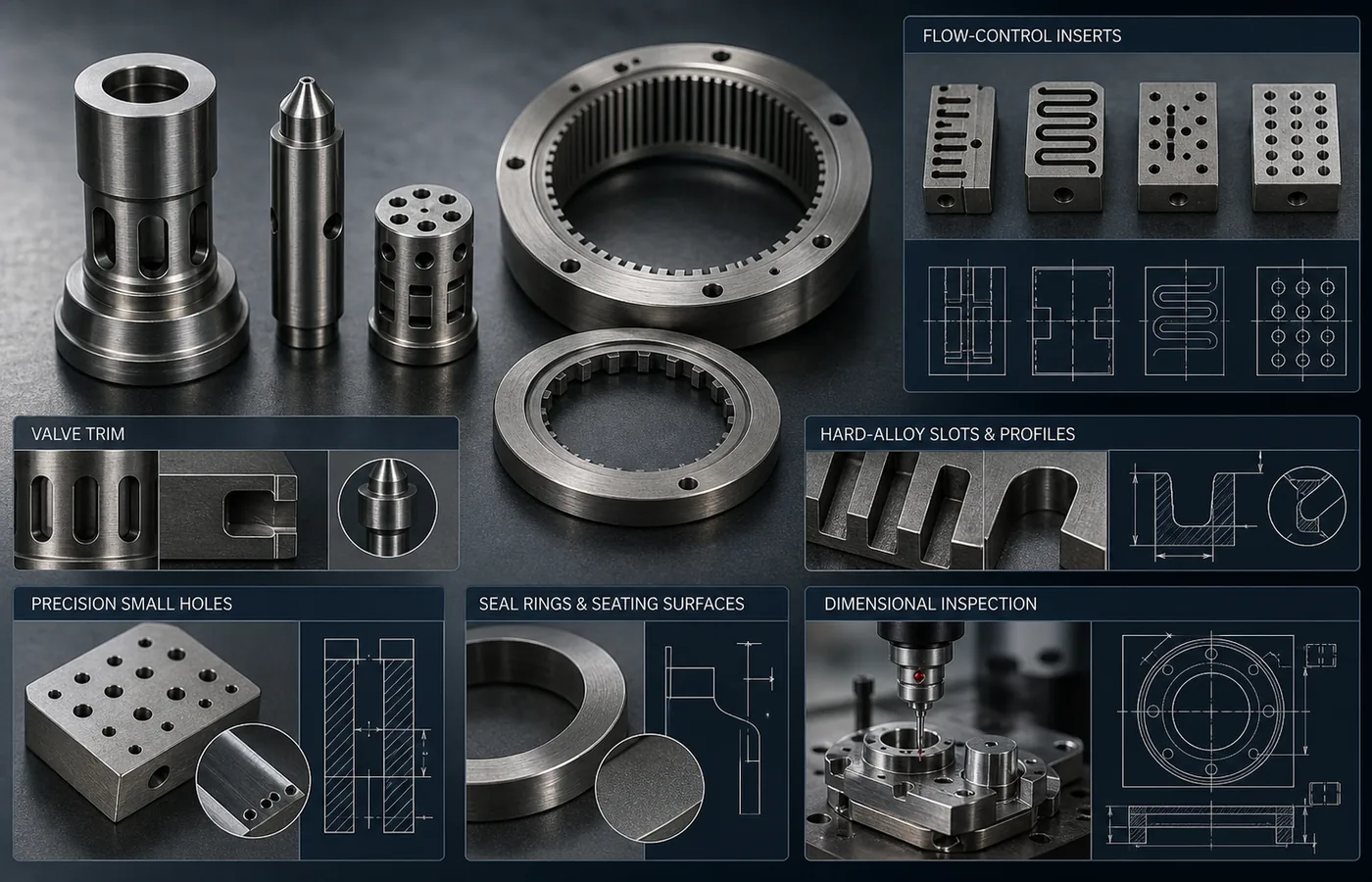
Energy and oil/gas EDM planning focuses on seal features, hard alloys, slots, small holes, wear details, corrosion surfaces, and traceable inspection. Energy and oil/gas components fail at sealing, fatigue, corrosion, or pressure-critical faces.
Quick Answer
Energy and oil/gas EDM planning focuses on seal features, hard alloys, slots, small holes, wear details, corrosion surfaces, and traceable inspection.
Application Planning Points
What's at Stake
Recast, corrosion damage, seal leakage, or missing material/inspection records can outweigh nominal dimensional success. The consequence changes fit, function, or service performance for the Energy and Oil/Gas Components decision; it is not only a change in surface appearance.
How to Plan the Route
State pressure or seal function, material condition, corrosion surface, and the dimensions that control assembly before routing each feature. When planning Energy and Oil/Gas Components, apply the requirement only to the dimensions and faces that control fit, function, service life, or documented release.
What Can Go Wrong
Energy and oil/gas components fail at sealing, fatigue, corrosion, or pressure-critical faces. Releasing the part from size and Ra alone can leave recast, cracks, or edge damage on the surface that controls service integrity.
How EDM Fits
Energy and oil/gas components use EDM where pressure, sealing, hard alloys, and deep access make conventional tools unstable. Small Hole EDM can reach long metering or cooling paths without a broken drill, Wire EDM controls hardened seal profiles, and Sinker EDM forms blind flow or valve details. Hardness independence preserves geometry through the cut, but recast, corrosion, and pressure-boundary inspection must be specified on the functional faces.
EDM for Energy and Oil/Gas Components Reference
| What you're asking | What you can expect |
|---|---|
| Planning axis | What to define |
| Part function | working feature and failure consequence |
| Process access | through, blind, hole, or micro |
| Material | grade and condition |
| Surface | functional face and post-process |
| Inspection | datum, method, report, and sample |
Material and Feature Context
Use conventional machining on open geometry and keep EDM on the hardened, inaccessible, burr-sensitive, or miniature features that justify it. Energy and oil/gas components fail at sealing, fatigue, corrosion, or pressure-critical faces.
Functional Surface Requirements
Assign surface, edge, and sub-surface requirements only where they affect function, and give each requirement its own acceptance method. For Energy and Oil/Gas Components, tie the accepted condition to the feature and inspection method named in the drawing.
Energy and Oil/Gas Components Drawing and Release Checkpoints
- Identify the controlled feature, material condition, access direction, and functional datum for this Energy and Oil/Gas Components decision.
- Separate dimensional requirements from texture, edge, recast, corrosion, fatigue, or post-process acceptance.
- State the inspection method, sampling or first-article requirement, drawing revision, quantity, and any documentation needed for release.
Limits and Better Alternatives
Main Limit
For EDM for Energy and Oil/Gas Components, the guide applies to the named technical decision and does not replace the drawing-specific review of geometry, material, setup, and inspection. When that boundary dominates, use conventional machining on open geometry and keep EDM on the hardened, inaccessible, burr-sensitive, or miniature features that justify it.
Practical Next Step
Assign surface, edge, and sub-surface requirements only where they affect function, and give each requirement its own acceptance method. State pressure or seal function, material condition, corrosion surface, and the dimensions that control assembly before routing each feature.
What to Remember
Energy and oil/gas EDM planning focuses on seal features, hard alloys, slots, small holes, wear details, corrosion surfaces, and traceable inspection. Tie the EDM route to the actual part feature, service failure mode, material state, and inspection evidence.
Technical Reference
Use the values as planning references and define the functional requirement on the controlled drawing.
Use This Guide to Prepare Your RFQ
Contact us when your drawing and requirements are ready for review.
- Drawing or part sketch
- Material grade
- Thickness / part size
- Quantity
STEP/STP, DXF, DWG, PDF, IGS/IGES or ZIP.
Confidential drawing review. NDA support available on request.
Frequently Asked Questions
What selects the EDM process?
Feature access and scale, not the industry label alone.
Why are functional surfaces important?
They determine edge, finish, recast, corrosion, and post-processing.
Can several processes be used?
Yes. Hybrid routing is common.
What should be sent?
Send the drawing, material condition, critical feature, surfaces, quantity, and inspection needs.