
Technical Reference
EDM Burrs And Edge Quality Technical Reference
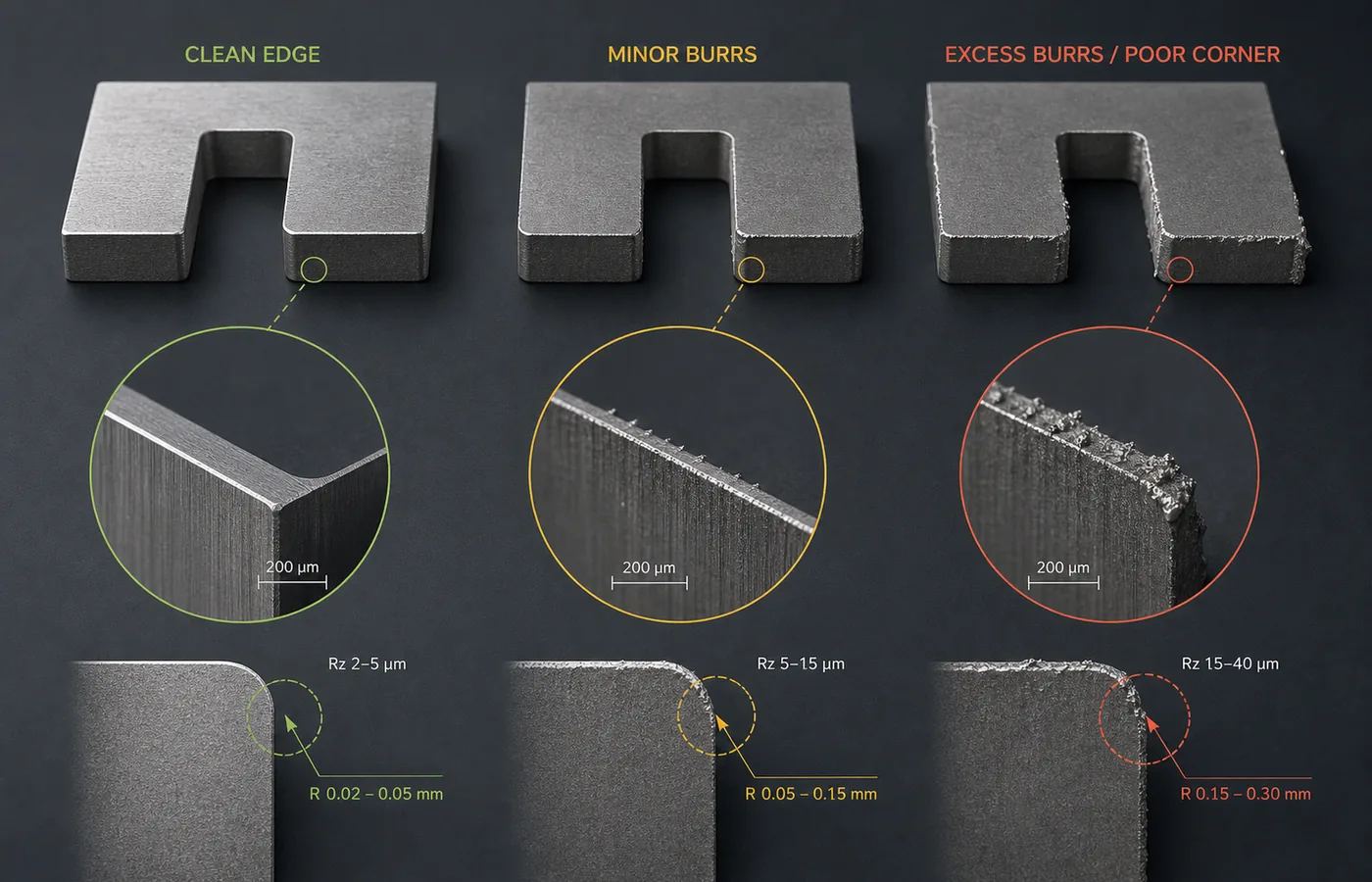
EDM edge quality is defined by final radius, recast, microchipping, rollover, debris, and how the edge carries function—not by the word “burr-free” alone. Edge quality fails when burr, rollover, recast, chipping, and radius are collapsed into one visual check.
Quick Answer
EDM edge quality is defined by final radius, recast, microchipping, rollover, debris, and how the edge carries function—not by the word “burr-free” alone.
Key Surface Points
What the Surface Requirement Means
Over-polishing can round a functional edge, while no secondary operation can leave rough-discharge debris or recast on a critical edge. The consequence changes fit, function, or service performance for the Burrs and Edge Quality decision; it is not only a change in surface appearance.
How to Control It
Mark cutting, sealing, contact, wear, and cosmetic edges separately and define the allowed radius or break. When planning Burrs and Edge Quality, apply the requirement only to the dimensions and faces that control fit, function, service life, or documented release.
What Gets Missed
Edge quality fails when burr, rollover, recast, chipping, and radius are collapsed into one visual check. The drawing must state which edge is functional and define the measurable condition that releases it.
Technical Context
EDM edge defects occur at different locations for different reasons. Entry rounding is linked to gap and electrode wear; exit damage is linked to breakthrough support; recast lips are linked to discharge energy and debris; wire-break marks are linked to an unstable gap. Inspect each functional edge by location and defect type instead of treating all edge conditions as one burr measurement. This mechanism explains the limits and behavior that matter when planning Burrs and Edge Quality.
EDM Burrs and Edge Quality Reference
| What you're asking | What you can expect |
|---|---|
| Acceptance item | Define separately |
| Roughness | Ra and measurement method |
| Recast/white layer | limit or removal on named face |
| Microcracks | method, magnification, and acceptance |
| Edge | radius, break, chipping, or rollover |
| Post-process | polish, lap, grind, stress relief, or passivation |
Inspection and Post-Process
Map edge acceptance by location. Entry, exit, internal corner, and wire-break or breakthrough zones can fail for different reasons, so each functional edge needs its own defect type, limit, and inspection method. For Burrs and Edge Quality, tie the accepted condition to the feature and inspection method named in the drawing.
Burrs and Edge Quality Drawing and Release Checkpoints
- Identify the controlled feature, material condition, access direction, and functional datum for this Burrs and Edge Quality decision.
- Separate dimensional requirements from texture, edge, recast, corrosion, fatigue, or post-process acceptance.
- State the inspection method, sampling or first-article requirement, drawing revision, quantity, and any documentation needed for release.
Limits and Better Alternatives
Main Limit
For EDM Burrs and Edge Quality, one Ra value cannot approve recast, micro-cracks, edge damage, corrosion response, fatigue risk, or post-processing. When that boundary dominates, use lower-energy finishing, selective polishing/lapping/grinding, or a process redesign where the functional surface cannot accept the EDM-affected condition.
Consider Another Route When
Use lower-energy finishing, selective polishing/lapping/grinding, or a process redesign where the functional surface cannot accept the EDM-affected condition.
Practical Next Step
Label each functional edge by location and acceptance type. Separate entry rounding, exit breakout, internal-corner radius, recast lip, and wire-break marks so inspection does not reduce them to one generic burr note.
What to Remember
EDM edge quality is defined by final radius, recast, microchipping, rollover, debris, and how the edge carries function—not by the word “burr-free” alone. Release roughness, recast, cracks, edge condition, and post-processing as separate requirements wherever function demands it.
Technical Reference
Use the values as planning references and define the functional requirement on the controlled drawing.
Use This Guide to Prepare Your RFQ
Contact us when your drawing and requirements are ready for review.
- Drawing or part sketch
- Material grade
- Thickness / part size
- Quantity
STEP/STP, DXF, DWG, PDF, IGS/IGES or ZIP.
Confidential drawing review. NDA support available on request.
Frequently Asked Questions
Is Ra enough to approve the surface?
No. Roughness and metallurgical/edge condition are separate.
Which faces need detailed control?
Fatigue, seal, wear, corrosion, contact, cutting, and medical surfaces.
Can finishing reduce the affected layer?
Yes, but the pass or removal method and inspection must be defined.
Should every surface use the same requirement?
No. Restrict detailed acceptance to functional faces.