
Process & Material
Cemented Carbide Wire EDM Feasibility Review
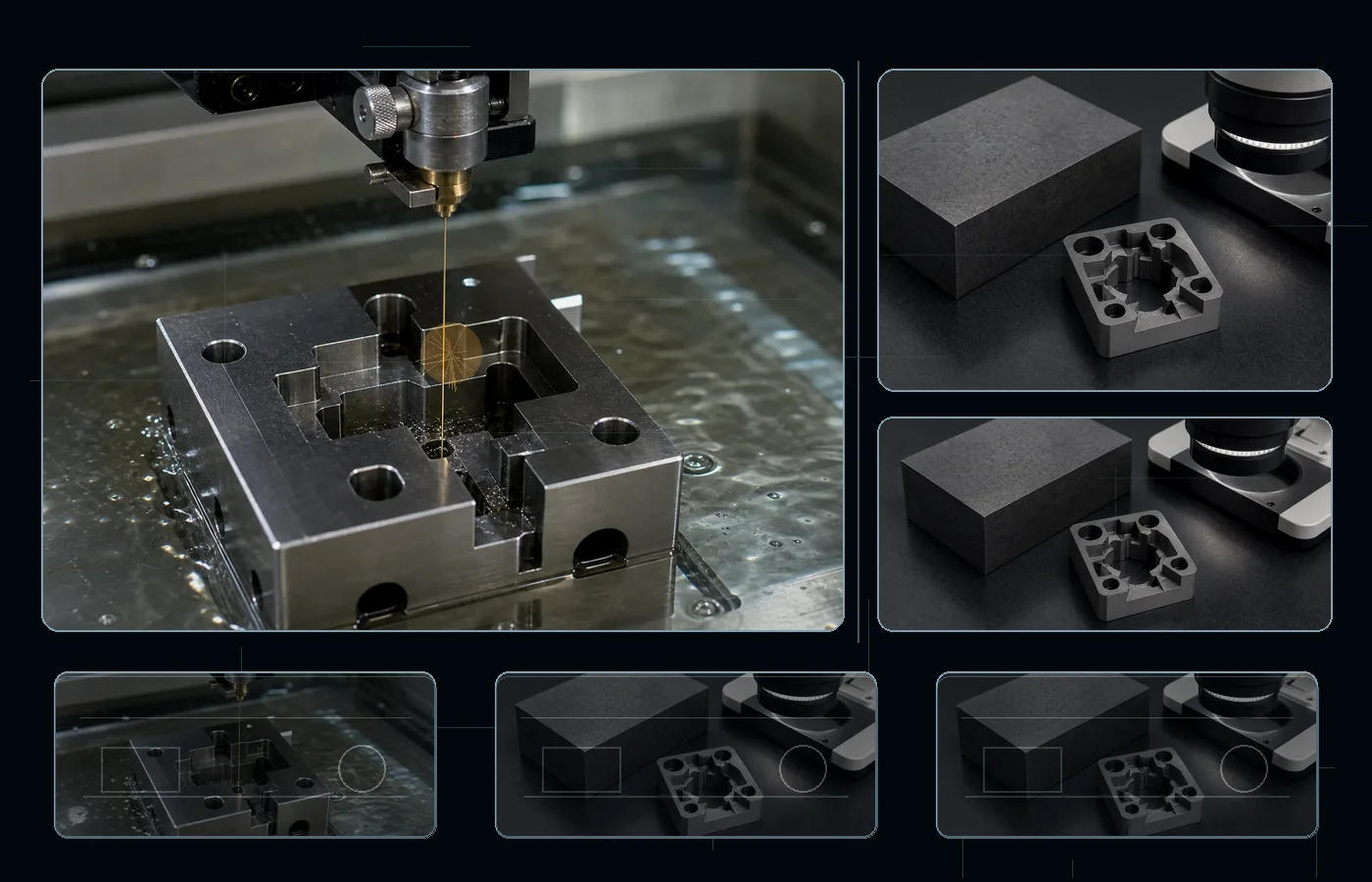
Cemented Carbide can be machined with Wire EDM when the geometry matches through profiles, precision slots, punches, inserts, cutouts, narrow webs, and tapered walls. Cemented Carbide is hard-metal composite with binder-dependent EDM response; the supplied condition affects support, discharge energy, finishing, and inspection.
Quick Answer
Wire EDM is suitable for Cemented Carbide when the wire can pass completely through the workpiece from an edge or a start hole. The supplied condition must be stated before tolerance and surface requirements are confirmed.
Key Material Decisions
How This Material Behaves
Hard-metal composite with binder-dependent EDM response. In Wire EDM, the supplied condition changes stress release during the through cut, edge response to trim passes, and the final corrosion or surface-protection route.
Choosing the Right Condition
Choose Wire EDM for through profiles, precision slots, punches, inserts, cutouts, narrow webs, and tapered walls. State the exact Cemented Carbide condition, then set tolerance, finish, support, and inspection from the controlled feature rather than the whole part.
Risks to Manage
For Wire EDM, aggressive energy can weaken edges or expose binder-rich zones. As the contour opens and the cut section loses restraint, the changing support condition can alter taper and datum position while the wire follows the programmed path; the interaction is most important at grain boundaries, brittle rims and subsurface damage zones. For Cemented Carbide, this can produce top-to-bottom chipping, taper or subsurface cracking on a brittle high-temperature material. For Cemented Carbide, use conservative discharge energy, strong local support and microscopic inspection of edges and subsurface damage. Inspect both cut edges and confirm the final profile after support tabs are removed; document geometry, chipping, grain pullout and subsurface cracking for Cemented Carbide.
How Wire EDM Works on Cemented Carbide
Wire EDM removes Cemented Carbide along a continuous through-cut with a moving wire electrode. Wire tension, guide alignment, flushing and trim-pass offset control kerf, taper, verticality and internal corner radius as the profile opens. The route requires a complete wire path from an edge or start hole and does not produce blind cavities.
Wire EDM Capability Reference
| What you're asking | What you can expect |
|---|---|
| Feature types | through profiles, precision slots, punches, inserts, cutouts, narrow webs, and tapered walls |
| Tolerance | ±0.005–0.025 mm |
| Surface finish | Ra 0.2–3.2 μm |
| Wire diameter | 0.10–0.30 mm planning range |
| Minimum internal corner | Approximately wire radius plus spark gap |
| Main limitation | Blind cavities and closed pockets are not wire-cut features. |
Material Condition Reference
| Condition | What to expect | Watch out for | Surface notes |
|---|---|---|---|
| as-sintered | Use low-force fixturing and conservative discharge energy. | Brittle edges can chip or binder-rich zones can erode unevenly. | Inspect edge breakout and surface integrity rather than Ra alone. |
| ground finish | Use stable support and reduced energy on finished stock. | Grinding stress or porosity can cause local cracking. | Apply selective polishing or lapping where practical. |
| polished or coated condition | Protect the final surface condition. | Coated, polished, or dense finished surfaces can be damaged by aggressive roughing. | Keep finishing local to the controlled feature. |
How This Material Behaves
Cemented carbide is a hard carbide skeleton held together by a metallic binder. In EDM, this means the binder can erode faster than the carbide grains, while aggressive energy can leave grain pullout, microcracks, or a weakened edge. Use low-energy finishing, strong flushing without impact on fragile corners, and verify critical surfaces by microscopy rather than roughness alone. For Wire EDM, aggressive energy can weaken edges or expose binder-rich zones. On open profiles, brittle edge response and thermal shock can appear as top-to-bottom chipping or subsurface cracking even without cutting force.
Surface Integrity and Post-Process
For Wire EDM on Cemented Carbide, use conservative energy, strong support and inspection focused on edge chipping and subsurface damage. Separate the rough cut from skim cuts and apply the fine finish only to functional edges. Inspect roughness, edge rounding, recast and corrosion or fatigue requirements after the final pass; include polishing, coating or protection allowance wherever it changes final size.
Cemented Carbide Wire EDM Checkpoints
- Confirm that the feature matches through profiles, precision slots, punches, inserts, cutouts, narrow webs, and tapered walls.
- State the supplied condition: as-sintered, ground finish, and polished or coated condition.
- Mark the controlled dimensions, functional surfaces, datum scheme, and inspection method.
Typical Parts and Features
- wear inserts
- high-temperature contacts
- hard-metal nozzles
- punches and die inserts
- precision profile gauges
- gear and spline outlines
Limits and Better Alternatives
Main Limit
Blind cavities and closed pockets are not wire-cut features because the wire needs a continuous through path. On Cemented Carbide, aggressive energy can weaken edges or expose binder-rich zones; the supplied condition still controls support, finishing, and surface-integrity review.
Consider Another Route When
Use Sinker EDM for blind cavities, CNC machining for accessible open geometry, or laser cutting when thin-sheet speed matters more than EDM edge quality.
Practical Next Step
Send the Cemented Carbide drawing with condition, controlled geometry, tolerance, functional surface callouts, quantity, and inspection requirements. If the route is unclear, we will compare Wire EDM with the adjacent EDM or conventional process.
Practical Takeaway
Cemented Carbide is compatible with Wire EDM when the feature matches the process access. The supplied condition determines support, finishing, surface control, and inspection.
Additional Project Information
Include application, destination and end-use notes together with the material, quantity and drawing requirements.
Project Details for Technical Review
Include application and end-use notes when they affect material, inspection, documentation, or export review.
- Process: Wire EDM
- Material: Cemented Carbide
- Drawing or part sketch
- Material grade
- Thickness / part size
- Quantity
- Tolerance and critical dimensions
- Surface finish or inspection requirement
STEP/STP, DXF, DWG, PDF, IGS/IGES or ZIP.
Confidential drawing review. NDA support available on request.