
Process & Material
440C Stainless Steel Sinker EDM Feasibility Review
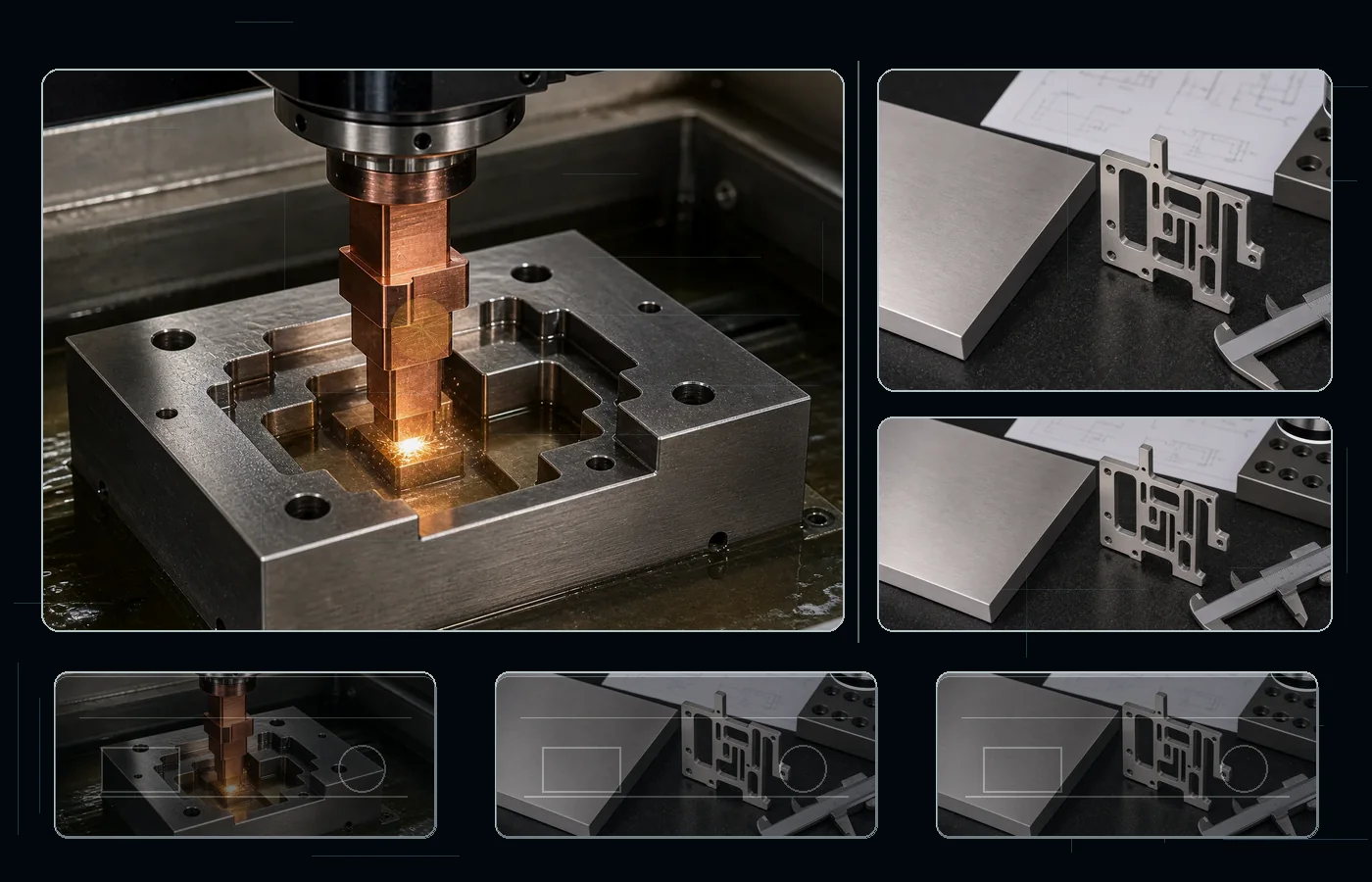
440C Stainless Steel can be machined with Sinker EDM when the geometry matches blind cavities, ribs, shaped pockets, mold details, deep forms, and internal geometry that a traveling wire cannot reach. 440C Stainless Steel is a high-carbon martensitic stainless bearing grade that can be supplied at high hardness; the supplied condition affects support, discharge energy, finishing, and inspection.
Quick Answer
Sinker EDM is suitable for 440C Stainless Steel when the feature is a blind cavity, rib, pocket, or internal form that a shaped electrode can reach from one side. The supplied condition must be stated before tolerance and surface requirements are confirmed.
Key Material Decisions
How This Material Behaves
A high-carbon martensitic stainless bearing grade that can be supplied at high hardness. In Sinker EDM, the supplied condition changes electrode wear, cavity-floor consistency, corner growth, and the finishing strategy—especially on deep ribs and textured surfaces.
Choosing the Right Condition
Choose Sinker EDM for blind cavities, ribs, shaped pockets, mold details, deep forms, and internal geometry that a traveling wire cannot reach. State the exact 440C Stainless Steel condition, then set tolerance, finish, support, and inspection from the controlled feature rather than the whole part.
Risks to Manage
For Sinker EDM, brittle hardened edges and bearing surfaces make finish energy and recast removal more important than roughing speed. While a blind cavity, deep rib or narrow pocket is being opened, orbit, local heating and electrode wear can shift wall size while dishing the floor; the interaction is most important at hardened edges, cutting lands and crack-sensitive corners. For 440C Stainless Steel, this can produce corner or floor error accompanied by brittle recast on the hardened cavity surface. For 440C Stainless Steel, support hardened edges, separate roughing from finishing, and inspect for chipping, white layer and microcracks. Compare the roughing electrode, finish electrode and final cavity rather than relying on nominal electrode size; document geometry, chipping, white layer and microcracks on hardened edges for 440C Stainless Steel.
How Sinker EDM Works on 440C Stainless Steel
Sinker EDM reproduces a shaped electrode as a blind cavity in 440C Stainless Steel. Electrode material, wear, orbit, pulse energy and debris evacuation control wall size, floor depth, corner definition and surface condition. Where final size or texture is critical, roughing and finishing electrodes should be planned as separate operations.
Sinker EDM Capability Reference
| What you're asking | What you can expect |
|---|---|
| Feature types | blind cavities, ribs, shaped pockets, mold details, deep forms, and internal geometry that a traveling wire cannot reach |
| Tolerance | ±0.008–0.030 mm |
| Surface finish | Ra 0.2–6.3 μm |
| Electrode choice | Graphite or copper selected from cavity, finish, and wear needs |
| Primary cavity limit | Depth, rib width, access, and debris evacuation |
| Main limitation | Electrode access and debris evacuation limit deep, narrow blind geometry. |
Material Condition Reference
| Condition | What to expect | Watch out for | Surface notes |
|---|---|---|---|
| annealed | Use stable support and identify the final heat-treatment route. | Softer condition can mark or move under clamping. | Separate cosmetic roughness from corrosion and passivation requirements. |
| hardened and tempered | Control cold-work stress and finish energy. | Cold-worked or welded zones can distort unevenly. | Inspect corrosion, seal, and fatigue faces separately. |
| stress-relieved finished condition | Use lower-energy finishing on hardened or aged faces. | A brittle recast layer or local heat tint can reduce corrosion and fatigue performance. | Use selective recast removal and passivation where required. |
How This Material Behaves
440C stainless steel contains high carbon and chromium carbides and is commonly used at high hardness. In EDM, this means carbide-rich surfaces can develop grain-scale pullout, brittle recast, or microcracks under aggressive roughing. Use conservative finish energy, avoid unsupported razor edges, and inspect bearing or fatigue surfaces beyond a simple roughness reading. For Sinker EDM, brittle hardened edges and bearing surfaces make finish energy and recast removal more important than roughing speed. In cavities, repeated local heating can concentrate recast at floors and corners, so temper, cleanliness and corrosion requirements must be released together.
Surface Integrity and Post-Process
For Sinker EDM on 440C Stainless Steel, sealing, fatigue and corrosion surfaces should separate roughness from recast-layer or passivation requirements. Use roughing and finishing electrodes separately where cavity size or texture is controlled. Apply polishing, lapping or recast removal only to named functional faces, and inspect wall, floor and corner condition after the final surface operation.
440C Stainless Steel Sinker EDM Checkpoints
- Confirm that the feature matches blind cavities, ribs, shaped pockets, mold details, deep forms, and internal geometry that a traveling wire cannot reach.
- State the supplied condition: annealed, hardened and tempered, and stress-relieved finished condition.
- Mark the controlled dimensions, functional surfaces, datum scheme, and inspection method.
Typical Parts and Features
- corrosion-resistant inserts
- medical and laboratory components
- connector features
- mold cavities
- blind pockets
- deep ribs
Limits and Better Alternatives
Main Limit
Electrode access and debris evacuation limit deep, narrow blind geometry. On 440C Stainless Steel, brittle hardened edges and bearing surfaces make finish energy and recast removal more important than roughing speed; the supplied condition still controls support, finishing, and surface-integrity review.
Consider Another Route When
Use Wire EDM for through profiles, CNC machining for open cavities with tool access, or grinding for simple flat precision surfaces.
Practical Next Step
Send the 440C Stainless Steel drawing with condition, controlled geometry, tolerance, functional surface callouts, quantity, and inspection requirements. If the route is unclear, we will compare Sinker EDM with the adjacent EDM or conventional process.
Practical Takeaway
440C Stainless Steel is compatible with Sinker EDM when the feature matches the process access. The supplied condition determines support, finishing, surface control, and inspection.
Request a Machining Feasibility Review
Send material grade, drawing files, tolerance and quantity. We confirm process fit before quoting.
- Process: Sinker EDM
- Material: 440C Stainless Steel
- Drawing or part sketch
- Material grade
- Thickness / part size
- Quantity
- Tolerance and critical dimensions
- Surface finish or inspection requirement
STEP/STP, DXF, DWG, PDF, IGS/IGES or ZIP.
Confidential drawing review. NDA support available on request.
Frequently Asked Questions
Can 440C Stainless Steel be machined with Sinker EDM?
Yes, when the feature is a blind cavity, rib, pocket, or internal form that a shaped electrode can reach from one side. 440C Stainless Steel is electrically conductive and the final route follows the feature geometry and supplied condition.
What controls Sinker EDM on 440C Stainless Steel?
The main process controls are electrode material, wear compensation, cavity depth, rib width, orbit strategy, debris evacuation, and rough-versus-finish electrodes. The 440C Stainless Steel condition adds dimensional-stability and surface-integrity requirements.
What is the main risk?
For Sinker EDM, brittle hardened edges and bearing surfaces make finish energy and recast removal more important than roughing speed. While a blind cavity, deep rib or narrow pocket is being opened, orbit, local heating and electrode wear can shift wall size while dishing the floor; the interaction is most important at hardened edges, cutting lands and crack-sensitive corners. For 440C Stainless Steel, this can produce corner or floor error accompanied by brittle recast on the hardened cavity surface. For 440C Stainless Steel, support hardened edges, separate roughing from finishing, and inspect for chipping, white layer and microcracks. Compare the roughing electrode, finish electrode and final cavity rather than relying on nominal electrode size; document geometry, chipping, white layer and microcracks on hardened edges for 440C Stainless Steel.
What should I send for review?
Send the drawing, exact 440C Stainless Steel condition, controlled geometry, tolerance, functional surface requirements, quantity, and inspection expectations. If any item is undecided, send what you have and we will help complete the review.